
-
Suresh Kalal
- January 5, 2026
- No categories assigned.
- No Comments
How to Use Chronicle for Threat Hunting Across Hybrid Environments
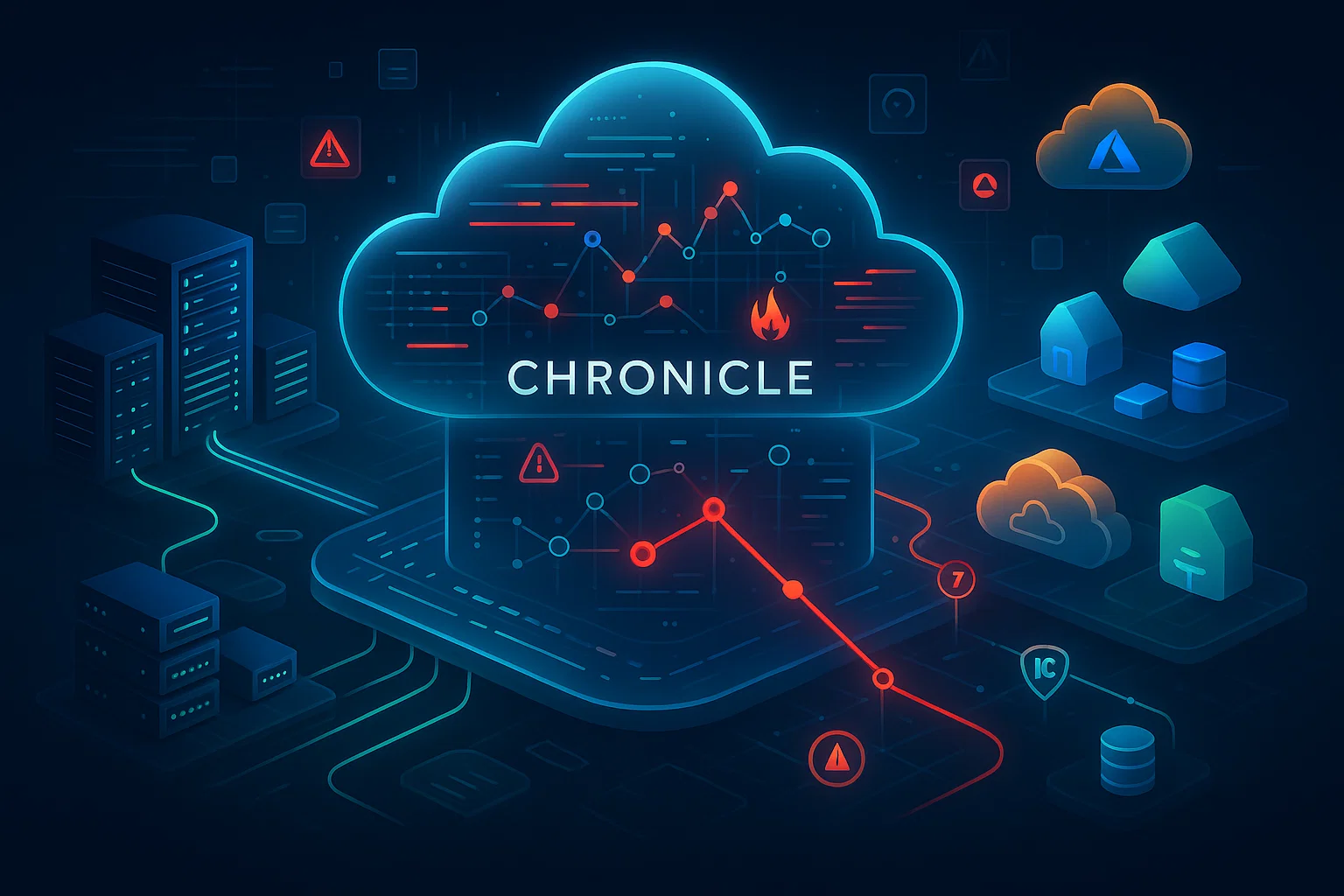
Today, threat hunting is not just about combing through cloud logs or endpoints — it’s about seeing everything. For modern era IT organizations with hybrid environments that consist of on-prem data centers, multiple cloud services and distributed endpoints having visibility that is somewhat fractured. That’s where Google Chronicle, now under the Google Security Operations umbrella, really shines. I’ll revisit that and show how leaders can use Chronicle for this: google chronicle threat hunting & SIEM investigation in a hybrid environment.
Understanding Chronicle in a Hybrid Setup
Chronicle is, at heart, a cloud-native SIEM plus SOAR and threat intelligence mother lode on Google infrastructure. Unlike traditional SIEMs, which can don’t scale well or require customers to limit their logs to make it affordable, Chronicle is built to grab petabytes of telemetry (when you need it) and run lightning fast search.
It works across a variety of log sources: from on-prem firewalls and EDR agents to cloud APIs (AWS, Azure, GCP), identity providers, network flows and many more. What that looks like in practice: you have a single view across all your environments.
Why Chronicle Makes Threat Hunting Better
- Hyper-scale data retention
Chronicle supports 12 months of “hot” data retention, meaning your security teams can search through a full year of normalized telemetry without dealing with complex rehydration. Google+1 That’s a game changer for retroactive threat hunting when you’re trying to trace a slow-moving adversary. - Sub-second search performance
One of Chronicle’s standout features is blazing-fast search. Whether you’re querying raw logs or normalized events, you can run complex queries across petabytes of data in seconds. CyberProof For seasoned SOC teams, this speed enables proactive hunting — not just reacting to alerts, but exploring hypotheses about attacker behavior across time and infrastructure. - Context-rich investigation
When you detect a suspicious alert, Chronicle’s investigation workbench brings in context: entity views (e.g., user, host, domain), timelines, threat intelligence enrichment (from Mandiant, VirusTotal, etc.). Google Cloud+2Sameer Fakhoury+2 That means fewer false positives, and faster root-cause analysis. - Composite detections for sophisticated attacks
With Chronicle, you can build composite detection rules — rules that chain together multiple simpler rules so you catch multi-stage attacks. Google Cloud Documentation For example, an initial login from an unusual IP, followed by privilege escalation, then data exfiltration — composite rules let you detect that full kill-chain rather than isolated pieces. - Automation with SOAR
Chronicle isn’t just about detection. Its SOAR capabilities let you automate response through playbooks. Google Cloud+1 For recurring threat patterns — say phishing or ransomware workflows — you can codify the response, reduce manual toil, and scale your SOC efficiency.
Putting Threat Hunting into Practice with Chronicle
So, how do you actually use Chronicle for threat hunting in a hybrid environment? Here’s a pragmatic approach.
Step 1: Architect for Comprehensive Ingestion
- Begin by mapping out all your telemetry sources (on-prem servers, cloud workloads, network devices, identity systems).
- Use Chronicle’s ingestion mechanisms — forwarders, collectors, or APIs — to bring all that data into its Universal Data Model (UDM). Google Cloud Documentation
- Normalize the data so that hunting queries are consistent across log types.
Step 2: Define Threat-hunting Use Cases
- Identify high-risk scenarios relevant to your hybrid architecture: lateral movement, cloud misconfigurations, insider threats, data exfiltration.
- Build or adopt detection rules (including composite rules) aligned with MITRE ATT&CK patterns. Composite detection lets you link related events and spot multi-stage attacks. Google Cloud Documentation
- Use Google-curated detections or write custom ones via Chronicle’s detection engine. Google
Step 3: Run Proactive Hunts
- Use Chronicle’s sub-second search to run exploratory queries over long windows of your data. You can pivot across entities — from user to host to IP — quickly. CyberProof+1
- Hunt for behaviors rather than just indicators: for example, repeated failed logins across accounts, followed by unusual data access, followed by outbound connections.
- Enrich your findings with threat intel (VirusTotal, Mandiant). The built-in enrichment helps you prioritize what’s truly suspicious. Google Cloud
Step 4: Investigate Efficiently
- When a hunt or alert surfaces something interesting, use Chronicle’s investigation workbench or case management. Analysts can see entity graphs, timelines, and contextual intelligence. Sameer Fakhoury+1
- Use playbooks to automate repetitive investigation tasks, like fetching additional threat intel or grouping similar events. Google Cloud Documentation+1
- Leverage the graph investigator to map relationships between users, IPs, hosts, domains — helping you understand “who did what, when.” Google Cloud Documentation
Step 5: Close the Loop With Response
- For confirmed threats, execute automated or semi-automated playbooks. You can build custom flows to isolate hosts, revoke credentials, block IPs, or escalate to incident response. Google Cloud
- Use case metrics and dashboards to track SOC KPIs: detection rate, time-to-investigate, playbook execution, and analyst workload. Google Cloud+1
- Continuously refine: as you gather more hunting and detection data, evolve your rules, enrichments, and automation.
Addressing the Real-World Challenges
Of course, while Chronicle is powerful, it’s not magic. Here are some considerations (especially from a senior-leadership perspective):
- Skillset & tooling maturity: Teams may need to get comfortable with Chronicle’s UDM, its query language, and its detection paradigms.
- Integration effort: Defining and normalizing hybrid telemetry can be non-trivial, especially with legacy on-prem systems.
- Rule-engineering discipline: Composite detections are powerful, but poorly designed composite rules can generate noise or miss context.
- Cost vs ROI: While Chronicle’s pricing model is more predictable than capacity-based legacy SIEMs, you’ll need to justify its value via better detection coverage, faster investigations, and lower manual burden.
- Change management: Shifting threat hunting culture to a more data-driven, hypothesis-led model requires buy-in across SOC, engineering, and leadership.

Why This Matters for Your Business
From a strategic standpoint, investing in Chronicle for threat hunting across hybrid environments aligns with several business-critical goals:
- Operational Resilience: By centralizing and normalizing telemetry, you reduce blind spots — giving you confidence to detect sophisticated attackers before they escalate.
- Efficiency Gains: Sub-second search and automated response free up your analysts to do higher-value work. This has downstream benefits: lower dwell time, faster incident resolution, and better use of talent.
- Scalability: As your clients or business grow, Chronicle’s cloud-native design allows the security stack to scale seamlessly — no painful re-architecture every time log volume spikes.
- Cost Predictability: Rather than paying for storage, compute, or data volume in a fragmented way, Chronicle’s pricing model helps you forecast and control TCO. Google
- Competitive Edge: As a managed-IT provider or MSP, having a robust threat-hunting capability built on Chronicle elevates your security maturity — which can be a strong differentiator with enterprise clients.
Conclusion
Applying Google Chronicle for hunting threats in the hybrid cloud is not an additive luxury feature – it’s increasingly a strategic necessity. With that scale, velocity, intelligence and automation of Chronicle – it allows your security teams to not just react to threats, but rather proactively hunt for, investigate and remediate incidents maintaining a single view across both cloud and on-prem.
For IT leaders, the question isn’t if — but how quickly and thoughtfully you can adopt Chronicle, so your SOC doesn’t just keep up but remains at the leading edge.
Recent Posts
- Building a High-Performance VPN Mesh for Distributed Teams
- Building Resilient VPN Architectures Using Route-Based VPN and Tunnel Interfaces
- Understanding SonicWall DPI-SSL Architecture and Its Impact on Throughput
- Advanced Threat Prevention: Inline ML and DNS Security Architecture Explained
- App-ID: How Palo Alto Firewalls Identify Traffic Beyond Ports & Protocols
Recent Comments
- ISO 27001 Certification Audit on The Impact of Quantum Computing on Cybersecurity: Preparing for the Future
- ISO 27001 Certification Audit on The Impact of Quantum Computing on Cybersecurity: Preparing for the Future