
-
admin
- December 15, 2025
- No categories assigned.
- No Comments
Designing Multi-Vendor Networks: Policy Normalization & Rule Harmonization
In the IT world of today, you’re hard-pressed to walk into any network that doesn’t run more than one vendor’s security stack. Organizations grow, join forces, go cloud-first or adopt best-of-breed tools — and they wind up with Fortinet firewalls here… Palo Alto there—Cisco ASA (or FTD) at the edge and some mix of Sophos or Check Point to secure specific business units. The upshot is a network that functions, if not always one that’s easy to manage.
And when security teams start consolidating policies, refactoring legacy rules, or gearing up for automation there’s a big question: How do you normalize and standardize firewall policies across several vendors without sacrificing security posture or operational visibility?
This is when multi-vendor firewall policy normalization and rule harmonization are also needed.
Why Multi-Vendor Policy Harmonization Has Become Non-Negotiable
Modern IT environments generate security complexity at scale. Even when every firewall is properly configured, every device patched, and every rule reviewed periodically, different vendors express security logic in different ways.
A simple example:
- One firewall uses zones, another uses interfaces.
- One supports layer-7 applications natively, another relies heavily on protocol + port combinations.
- Some evaluate rules top-down, others perform rule matching based on best fit.
- NAT, routing precedence, and object hierarchies differ wildly from vendor to vendor.
So even when two firewalls enforce the “same” policy, their underlying rule structures might be completely different.
As networks expand globally and security teams adopt hybrid-cloud operations, these differences multiply. Without normalization, the environment becomes harder to audit, harder to automate, and far more prone to misconfigurations—especially during migrations, technology refreshes, or compliance audits.
Understanding Policy Normalization
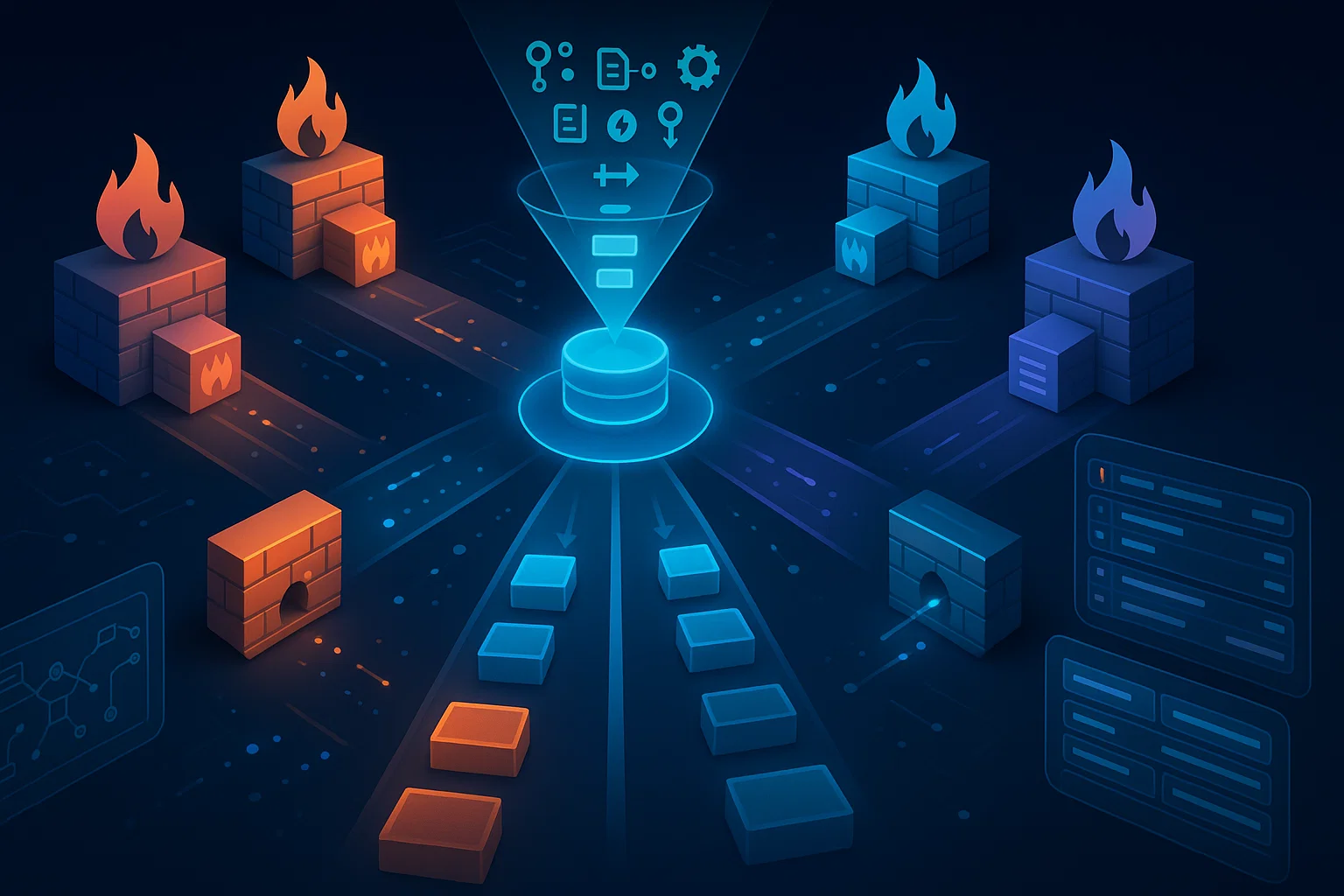
Policy normalization is the process of translating vendor-specific security rules into a common, vendor-neutral model.
Think of it like converting multiple spoken languages into a single structured format before processing them.
Key elements typically normalized include:
- Objects & Addresses
- Standardizing naming conventions
- Mapping vendor-specific object structures
- Consolidating redundant objects
- Services & Applications
- Aligning port/protocol definitions
- Mapping vendor-specific application signatures
- Normalizing custom app definitions
- Security Rules
- Flattening rule sets
- Standardizing rule logic
- Converting vendor-specific rule behaviors into a neutral representation
- NAT Rules
- Aligning source, destination, and PAT/SNAT/DNAT conventions
- Simplifying complex vendor-specific NAT chains
- Logging & Enforcement Profiles
- Standardizing logging levels
- Mapping security profiles (IPS/AV/Threat Prevention/Web Filtering)
When this normalization model is built correctly, it acts as a foundation for automation, auditing, optimization, and cross-vendor policy comparison.
Why Normalization Matters
1. Better Visibility Across the Estate
A normalized rule set lets teams see exactly what is being permitted or denied across all platforms. Without it, comparing policies across multiple vendors is a manual, inefficient, and error-prone exercise.
2. Stronger Security
Misalignments cause gaps. For example:
- Vendor A may treat an ANY-ANY rule differently than Vendor B.
- Palo Alto might identify applications dynamically, while a Cisco ASA may rely on static port definitions.
Normalization highlights these inconsistencies before they become vulnerabilities.
3. Compliance and Audit Readiness
Auditors want to see whether firewall policies follow corporate standards. With multi-vendor setups, normalized policies drastically reduce audit effort and ensure consistent documentation.
4. Easier Migrations
Migrating from one vendor to another (e.g., ASA → Palo Alto, Fortinet → Cisco FTD, Sophos → FortiGate) is significantly easier when a normalized policy baseline exists.
5. Automation and Orchestration
Tools like Terraform, Ansible, or security orchestration platforms depend on standardized data structures. A normalized policy model makes end-to-end automation practical.
Rule Harmonization: Going Beyond Normalization
Normalization makes policies look similar.
Harmonization makes policies work together.
Rule harmonization ensures that security rules across multiple vendors enforce the same intent—even if the syntax or capabilities differ.
Harmonization Focuses On:
- Intent Matching:
Ensuring every firewall interprets the security requirement the same way. - Risk Alignment:
Ensuring rules across platforms offer equal threat protection levels. - Optimization:
Cleaning duplicates, removing shadows, consolidating object groups, and improving rule order. - Consistency Checks:
Detecting mismatches like:- Allowing RDP on one firewall but blocking it elsewhere
- Different IPS signatures applied to the same traffic
- Inconsistent outbound filtering
- Shadow or unused rules causing unexpected behavior
Why Harmonization Matters
A harmonized policy reduces:
- Operational friction
- Audit complexity
- Vendor-based policy drift
- Human-introduced rule inaccuracies
It also strengthens zero-trust initiatives, segmentation strategies, and cloud-edge alignment.
Practical Challenges in Multi-Vendor Rule Harmonization
1. Inconsistent Feature Sets
Some vendors support advanced app-ID; others rely on traditional port-based matching. This means you must decide whether to adopt the lowest common denominator or use vendor-specific capabilities where available.
2. Object Model Differences
- Palo Alto uses hierarchical objects.
- FortiGate has service groups with different limits.
- Cisco ASA handles objects differently.
- Sophos has unique types like service definitions tied to modules.
Mapping these into a unified structure takes careful planning.
3. Handling Legacy & Shadow Rules
Decades-old firewalls might contain:
- Disabled rules that still impact evaluation
- Unused rules
- Shadowed policies that never get hit
- Redundant objects created by multiple administrators
Harmonization requires deep rule cleanup—often the hardest part of the job.
4. Risk Scoring Differences
Each vendor measures rule risk differently. Harmonization requires converting vendor-specific risk scores into a unified rating model.
5. Application Awareness Mismatches
If one firewall supports granular application visibility but another doesn’t, intent-based rule comparison becomes more complex.
How To Approach Multi-Vendor Policy Normalization & Harmonization
1. Build an Abstracted Policy Model
Start with a vendor-neutral structure:
- Sources
- Destinations
- Services
- Applications
- Security profiles (IPS/AV/Web Filtering)
- Action
- Logging
- Comments / Business Justification
This model should withstand conversion between vendors.
2. Extract Policies From Each Platform
Use APIs, configuration exports, or automation tools to collect:
- Security rules
- NAT rules
- Objects
- Address groups
- Service groups
- Application signatures
- Threat profiles
3. Standardize Naming Conventions
Create a naming schema applicable across vendors:
SRC-<Location>-<Department>APP-<ServiceName>-<Port>DST-<System>-<Environment>
This eliminates inconsistencies and improves lifecycle management.
4. Map Rule Intent
This is the heart of harmonization. For each rule, identify:
- What business function it serves
- Whether it’s still required
- Whether the intent is consistent across firewalls
5. Remove Redundant or Risky Policies
Cleanup includes:
- Shadow rules
- Rules with overly broad ANY constructs
- Temporary rules that were never removed
- Duplicate objects
- Unused address groups
6. Normalize NAT
NAT behavior differs wildly across vendors. A normalized NAT structure eliminates ambiguity.
7. Re-Apply Harmonized Policies to Each Vendor
Once the common model is finalized, policies can be re-expressed in vendor-specific syntax:
- PAN-OS
- FortiOS
- Cisco ASA/FTD
- Sophos XG
This creates a consistent, unified policy posture.
8. Implement Automation for Ongoing Consistency
Automation becomes possible once normalization is complete:
- Rule creation workflows
- Risk scoring
- Policy impact analysis
- Change control approvals
- Automated documentation
- Continuous compliance monitoring
The Role of AI & Automation Tools
AI-driven security platforms and rule-analysis tools are increasingly assisting with:
- Policy recommendation
- Duplicate detection
- Policy conflict identification
- Rule optimization
- Compliance scoring
- Cross-vendor comparison
Machine learning models can identify anomalies and recommend harmonized policies based on network behavior.
These tools don’t replace human decision-making, but they accelerate the harmonization process significantly.

A Future Where Multi-Vendor Harmonization Becomes Standard Practice
As networks stretch across data centers, branches, cloud platforms, and remote endpoints, multi-vendor setups will continue to be the norm. With zero trust, micro-segmentation, and SASE adoption growing, harmonized security policies become foundational—not optional.
Organizations that invest in normalization and harmonization gain:
- Faster response to incidents
- Predictable and consistent security behavior
- Lower operational overhead
- Strong audit posture
- Easier transition to new vendors or platforms
The payoff is long-term: simplified management today, and accelerated modernization tomorrow.
Conclusion
Running a multi-vendor network is more than just deploying multiple firewall platforms. The issue, however, is providing consistent policy enforcement; visibility across disparate systems and reducing the complexity of such rules without impacting security.
Policy normalization presents teams with a single, consistent view of their security posture. Harmonization of rules makes it possible that policies are enforced with consistent semantics by several manufacturers. Collectively, they lower risk, reduce complexity, drive efficiency and enable automation to secure the architecture for the future.
With the networks continuing to grow and change, those organizations that are realizing this dream today will be better prepared to adjust rapidly, apply zero-trust principles uniformly, and maintain a strong security posture — regardless of the firewall vendors they select.
Recent Posts
- Implementing Real-Time Security Monitoring With Security Command Center
- How to Use Chronicle for Threat Hunting Across Hybrid Environments
- How Pay-as-You-Go IT Support Is Redefining Tech Operations
- Building a Resilient IT Infrastructure for the Always-On Era
- Comparing SSL/TLS Decryption Across Cisco, Palo Alto, Fortinet & Sophos
Recent Comments
- ISO 27001 Certification Audit on The Impact of Quantum Computing on Cybersecurity: Preparing for the Future