
-
Suresh Kalal
- February 16, 2026
- No categories assigned.
- No Comments
Advanced Threat Prevention: Inline ML and DNS Security Architecture Explained
Today’s attack traffic is no longer what it used to be. Signatures cannot keep pace by themselves, and tradit ional DNS filtering is too slow to prevent real-time threats, while new malware variants frequently slip through even well-maintained security stacks. And this is precisely where Palo Alto’s Advanced Threat Prevention, inline machine learning (inline ML), and DNS Security architecture combine.
The focus of this article is what these functions actually do — not the marketing, but the operational flow that you need when you are responsible for uptime, risk reduction and explainable security outcomes. Consider this my less theoretical deep dive into the architecture, what makes inline ML so critical here and how DNS Security fits in with the broader full threat prevention pipeline.
Why Traditional Threat Prevention Hit Its Limit
For years, threat detection systems were built around signatures, sandboxes, and static analysis. The model worked reasonably well—until attackers got faster.
A few ongoing challenges made legacy approaches insufficient:
- Zero-day attacks are now the norm, exploiting gaps before vendors can release signatures.
- Polymorphic malware and fileless attacks can mutate faster than signature engines can update.
- DNS abuse has exploded, from command-and-control callbacks to domain-generated algorithms (DGAs).
- Encrypted traffic dominates, making payload visibility harder without smarter analysis.
To counter this, Palo Alto redesigned parts of their threat prevention architecture to work in-line, in real time, and without the delays caused by sandbox roundtrips.
Inline ML: Real-Time Prevention With No Sandbox Dependency
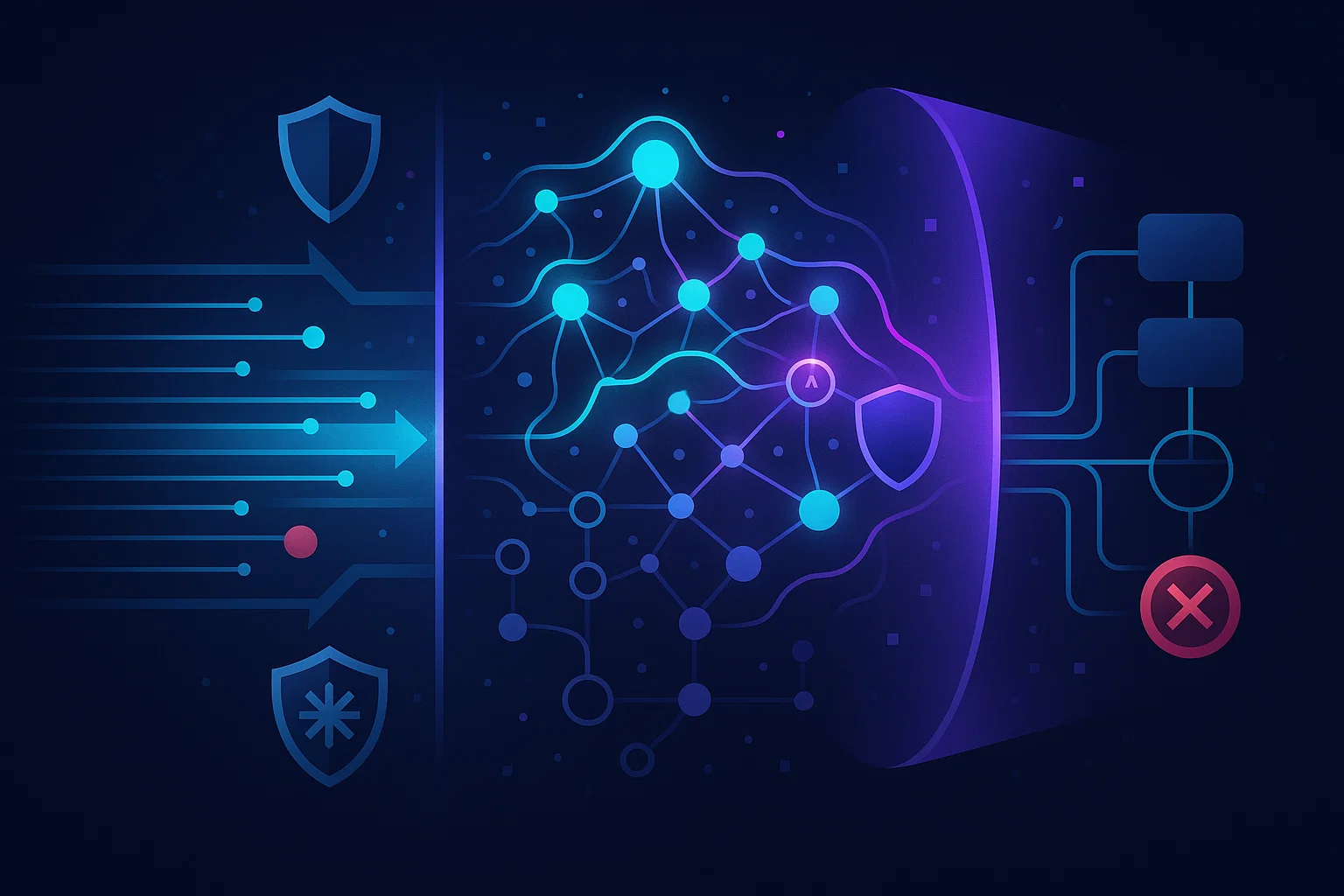
Inline machine learning changes the conversation. Instead of sending unknown files to a cloud sandbox, waiting for detonation results, and applying signatures later, inline ML performs sub-millisecond behavioral analysis on live traffic.
How Inline ML Works (Without Adding Latency)
At a high level, inline ML models sit inside the threat prevention pipeline. As packets flow through the firewall:
- Packet arrives.
- Inline ML engine evaluates features extracted from the file or traffic pattern.
- Prediction generated instantly—malicious, benign, or suspicious.
- Policy action applied immediately: block, alert, or allow.
No detonation. No cloud dependency. No multi-second scan. It’s prevention, not detection.
What Inline ML Models Actually Look For
Inline ML isn’t scanning for signatures—it’s analyzing behaviors and patterns such as:
- Code entropy and obfuscation patterns
- Malicious macro characteristics
- API call sequences
- Embedded command chains
- Anomalous encoding
- File structure deviations
- Payload characteristics in encrypted or partially encrypted flows
These are the signals attackers cannot easily randomize without breaking their payload.
Because analysis happens directly in the packet processing path, blocking occurs before the threat has any chance to execute.
Why This Matters in Real IT Environments
In practice, this solves several long-standing operational challenges:
- Zero-day blocking becomes immediate—no waiting for signature updates.
- Malicious tools disguised as “trusted” file types can be caught using behavioral patterns.
- Real-time response means SOC teams don’t have to rely solely on post-event forensics.
- Works at scale—the ML models are lightweight enough for consistent throughput even on busy firewalls.
For organizations dealing with thousands of endpoints, remote sites, or cloud workloads, inline ML adds a “dynamic shield” where traditional security layers are too slow.
DNS Security: The Other Half of Modern Threat Prevention
Inline ML handles payload-level risks. DNS Security handles everything that relies on DNS resolution—a huge vector in modern attacks.
Think about the last year of incidents. Almost every ransomware family, botnet strain, or remote execution kit uses DNS for one or more of the following:
- Initial callbacks
- Payload downloads
- Stolen data exfiltration
- DGA-based domain hopping
- DNS tunneling for covert C2 communication
Palo Alto DNS Security is built to address exactly this, working as part of the same threat prevention pipeline.
How DNS Security Works Under the Hood
1. Real-Time DNS Classification
DNS Security uses a combination of:
- Real-time ML scoring
- Passive DNS telemetry
- Live threat intelligence feeds
- DGA prediction models
- Reputation analysis
When a user or system attempts to resolve a domain, the firewall checks the request against the DNS Security intelligence layer. If the domain is malicious, suspicious, or newly registered (a huge risk indicator), the firewall blocks or sinks the query.
2. Inline ML for DNS Behaviour
Inline ML also applies to DNS. Instead of simply checking domain reputation, ML models evaluate:
- Domain lexical patterns
- Registration patterns
- Query frequency anomalies
- DGA characteristics
- Host communication patterns
This is crucial for identifying “zero-second” malicious domains—domains that have just been created and aren’t yet in any reputation database.
3. Protection Against DNS Tunneling
DNS tunneling is a major blind spot for many organizations. Attackers encode data inside DNS queries to bypass firewalls or DLP tools.
DNS Security detects tunneling by analyzing:
- Query length anomalies
- Base32/Base64 encoded payloads
- High-frequency lookups
- Suspicious subdomain structures
- Non-standard response patterns
Stopping tunneling at the DNS layer closes a major escape route for attackers.
Putting It Together: The Full Threat Prevention Architecture
When you combine inline ML with DNS Security, the architecture forms a multi-layered defense stack:
1. Packet Flow Begins
Traffic enters the firewall and is normalized. Protocol decoding starts.
2. Signature and Heuristic Engines
Static analysis engines check against known threats.
3. Inline ML Models Execute in Real-Time
The ML engines evaluate payload features, DNS queries, and traffic behavior.
- File-based threats are scored instantly
- Suspicious DNS requests are blocked before resolution
- Behavioral anomalies are flagged
4. Policy Enforcement
Depending on your policy configuration:
- Malicious traffic is blocked
- Suspicious traffic is challenged or logged
- Benign traffic passes
5. Cloud-Assisted Analysis (Optional)
If enabled, unknown files can still be sent to WildFire or cloud analysis.
But the difference: you don’t need cloud analysis to make the initial block anymore.
6. Threat Intelligence Feedback Loop
Threats identified via inline ML and DNS Security feed back into Palo Alto’s global intelligence engine, improving the models and signature databases over time.
Why Inline ML + DNS Security Outperforms Legacy Stacks
1. Zero-Delay Prevention
Inline ML makes blocking instantaneous. There’s no reliance on sandbox detonation cycles.
2. Better Against Unknown Threats
Attackers can evade signatures.
They struggle to evade behavior-based ML.
3. DNS Becomes a First-Class Security Layer
Many security stacks treat DNS as an afterthought.
DNS Security elevates DNS to a real prevention checkpoint.
4. Lower SOC Noise
When threats are blocked at the edge:
- Fewer alerts
- Fewer incidents
- Shorter investigation cycles
Your SOC focuses on real threats, not cleanup tasks.
5. No Dependency on External Infrastructure
Inline ML does not require cloud connectivity.
Detection continues even in air-gapped or high-security environments.
Inline ML and DNS Security for Cloud, Remote Sites, and Hybrid Environments
Modern networks aren’t just offices anymore. Remote employees, SaaS traffic, cloud workloads, and distributed applications have changed the topology.
Inline ML and DNS Security fit well into these architectures because:
- They work the same way on physical firewalls, virtual firewalls, and cloud firewalls.
- They maintain consistent protection across all traffic paths.
- They are effective even with encrypted traffic (thanks to metadata analysis and decryption policies).
This consistency across deployment models is one of the biggest advantages for organizations with hybrid or multi-cloud environments.

What This Means for Strategic Security Planning
If you’re planning the next stage of your security roadmap, the move toward real-time ML-driven prevention isn’t a “nice to have”—it’s becoming the standard.
Inline ML and DNS Security help organizations:
- Reduce reliance on delayed signature updates.
- Automatically adapt to new attack techniques.
- Close DNS-based threat gaps that most firewalls miss.
- Simplify security operations through real-time blocking.
- Improve protection without adding latency or complexity.
The architecture supports a long-term model where prevention happens earlier, faster, and with higher accuracy.
Conclusion
Palo Alto’s Advanced Threat Prevention – with inline ML and DNS Security – is fundamentally unlike legacy detection ways. It moves security from being reactive analysis to proactive, live prevention. Inline ML ensures that malicious activity is detected immediately, despite the absence of a signature. With DNS Security, attackers lose a secure comms channel.
Collectively, they are a state-of-the-art threat defense model designed for the future—distributed, encrypted, and dynamically responding to new attacks. This architecture provides a significantly more robust first line of defense for companies that require reliable, scalable and smart security controls, without imposing additional operational burden.
Recent Posts
- Config Drift: The Silent Breaker of Large-Scale Network Environments
- Building a High-Performance VPN Mesh for Distributed Teams
- Building Resilient VPN Architectures Using Route-Based VPN and Tunnel Interfaces
- Understanding SonicWall DPI-SSL Architecture and Its Impact on Throughput
- Advanced Threat Prevention: Inline ML and DNS Security Architecture Explained
Recent Comments
- ISO 27001 Certification Audit on The Impact of Quantum Computing on Cybersecurity: Preparing for the Future
- ISO 27001 Certification Audit on The Impact of Quantum Computing on Cybersecurity: Preparing for the Future