
-
Vijit
- November 23, 2026
- Outsource IT
- No Comments
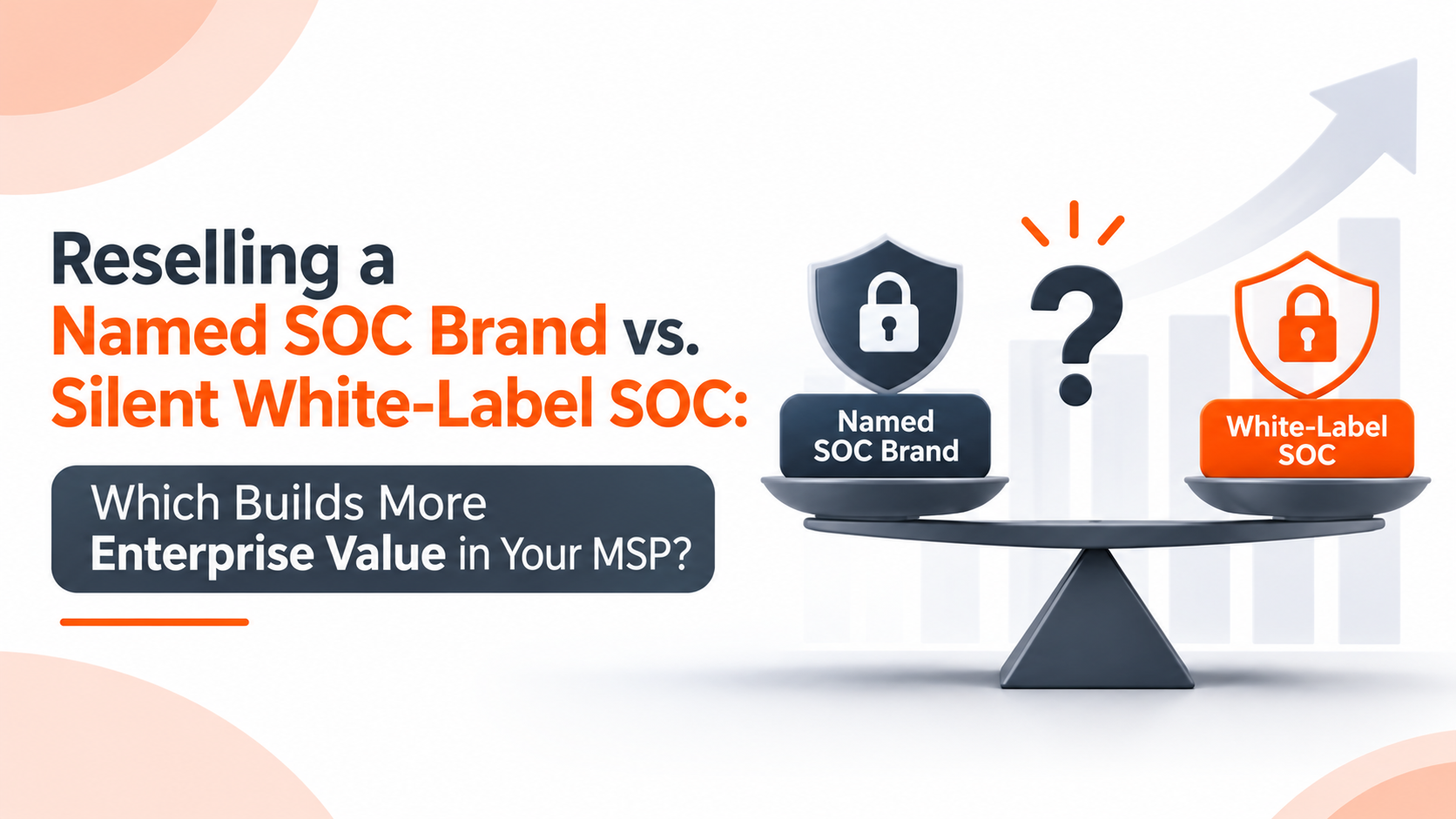
When MSPs choose a security partner, the conversation is almost always about price, coverage, and detection quality. Branding gets treated as a cosmetic decision made late in the process: do we put the vendor’s logo on the report, or ours? That question is worth more attention than it gets, because it affects something most owners care about more than monthly margin, which is what the business is worth when you sell it, hand it on, or raise money against it.
The short version: neither model is automatically better for enterprise value. What matters is who owns the client relationship, how hard it is to change vendors, and what a buyer sees when they open the books. Let’s go through each.
What Buyers Actually Look At
Before comparing branding models, it helps to know what a serious acquirer or investor examines in an MSP’s security practice. The list is fairly consistent:
- Recurring revenue quality. How much of your revenue is contracted, how long contracts run, and how much security contributes.
- Retention. Client churn, particularly in the security tier.
- Gross margin on security. Not just revenue. A security line with thin margin adds less value than its size suggests.
- Concentration and dependency. How much of the business rests on one vendor, one partner, or one key person.
- Transferability. Whether contracts, tools, and relationships survive a change of ownership.
- Operational maturity. Documentation, SLAs actually achieved, incident history, and insurance.
Branding touches almost every item on that list. Let’s see how.
The Named-Brand Model
Reselling a named SOC brand means the client knows who runs the monitoring. The vendor’s name appears on reports, portals, or alerts, sometimes alongside yours, sometimes in place of it.
What it does well.
- Borrowed credibility. A recognized vendor name shortens the sales cycle, particularly with clients who’ve never heard of your MSP’s security capability. It answers “who’s actually watching our network?” with a name they know.
- Insurance and compliance alignment. Some cyber insurers and client questionnaires reference specific vendors or product categories. A recognized brand can make those boxes easier to tick.
- Vendor support. Partner programs often include marketing materials, training, certifications, and co-selling help.
- Buyer familiarity. If an acquirer uses the same vendor, your stack integrates with theirs easily. In that specific case, it’s an asset.
What it costs in enterprise value.
- Shared ownership of the relationship. The client knows the vendor and may be reachable by the vendor directly. Some programs restrict that, but you’re relying on contract language and goodwill.
- Brand equity accrues to the vendor. Every client you convince that this brand is trustworthy strengthens the vendor’s position, not yours. If you ever move vendors, you start over.
- Concentration risk. Buyers see a security line that depends on one named provider’s pricing, roadmap, and partner program terms. If the vendor changes terms, raises prices, or gets acquired, that’s your problem and, after a sale, your buyer’s.
- Less pricing power. When clients can look up what the vendor’s product costs, your markup is visible and harder to defend.
The Silent White-Label Model
In a silent white-label arrangement, the client sees your brand throughout: your portal, your reports, your analysts’ signature lines. The partner works behind the scenes.
What it does well.
- You own the relationship. The client’s trust attaches to you. If you change partners, the client may never notice, which is a significant protection for the value of your recurring revenue.
- Swappability. With the right contract and runbooks, you can replace a partner without client-facing disruption.
- Brand equity compounds for you. Every satisfied client strengthens your name in the market, and that carries over to a buyer.
- Pricing flexibility. You price on the value of your managed security service, not on a visible vendor rate card.
What it costs.
- You carry the credibility burden. Without a recognized name behind you, you need to earn trust through your own track record, certifications, and reporting.
- Buyers will diligence the partner. An acquirer will want to see the partner contract, SLA performance history, and incident record. A weak or undocumented partner relationship drags value down.
- A single partner is a single point of failure. Silence doesn’t remove dependency. It only hides it from clients. Buyers can still see it in your contracts.
- Disclosure obligations. Some frameworks and client contracts require disclosure of subcontractors that handle sensitive data. “Silent” shouldn’t mean undisclosed in the paperwork. Your client-facing experience can be white-labeled while your subprocessor list stays accurate.

The Real Switching Cost Isn’t the Logo
Here is the part owners miss. The cost of changing security providers is driven far more by technology than by branding. If the partner’s EDR agent sits on every client endpoint, a change means redeploying agents, rebuilding detection tuning, migrating log sources, and retraining your team on a new console. That cost is the same whether the client saw the vendor’s logo or not.
What branding changes is the client-facing part of a switch. Under a named-brand model, a vendor change means telling every client, handling their questions, and sometimes re-papering contracts. Under a silent model, you can run the migration quietly and explain it only as an improvement.
Here’s an illustration. These percentages are my assumptions, not benchmarks. Suppose your security line is $900,000 in annual recurring revenue. If switching vendors under a named-brand model costs you 10 to 15% of that revenue in client pushback and churn, that’s $90,000 to $135,000 at risk. Under a silent model, with the same migration but no visible change, you might lose 2 to 5%, or $18,000 to $45,000. The technical migration cost is identical in both. The difference is purely about who the client thinks they bought from.
A buyer will price in that exposure. A security line that’s easy to move without client friction is worth more than one that isn’t.
Which Builds More Enterprise Value
On the dimension that matters most to valuation, relationship ownership and transferability, silent white-label generally wins, provided it’s executed well. You own the client trust, you can change partners without a client event, and a buyer inherits a service they can run under their own brand.
That conclusion comes with conditions.
Silent white-label builds more value when you have documented SLAs, a clean partner contract with assignment and change-of-control terms that survive a sale, portable runbooks, and a track record you can show. It builds less when the partner relationship is informal, undocumented, or concentrated in one person’s head.
A named brand can build more value when your MSP is young in security and needs borrowed credibility to win clients, when your target buyers use the same vendor, or when your clients’ insurers or regulators favor specific vendors. In those cases, the brand is a practical asset, not just a dependency.
The hybrid is common and underrated. Many MSPs create their own branded security service, name it, package it, and own the client relationship, then disclose the technology stack in contracts and technical documentation. The client buys your service. The vendors behind it are named where transparency requires and not in the sales motion. This keeps the relationship yours without hiding facts that clients or auditors are entitled to see.
How to Protect Enterprise Value Either Way
Whichever model you choose, a handful of habits determine whether the security line is a valuable asset or a liability a buyer discounts.
- Own the contract with the client. Your agreement, your SLAs, your terms. Don’t let the vendor’s terms flow straight through.
- Negotiate assignment and change-of-control language in your partner agreement before you need it.
- Keep portable documentation. Runbooks, escalation rules, detection tuning notes, and client onboarding records should live in your systems, not just the partner’s.
- Track security margin separately. Buyers value gross margin by line. Know yours.
- Avoid single-vendor concentration where you can, or at least have a documented exit plan.
- Build services the partner can’t give you, such as advisory work, reporting, and client-specific response planning. Our piece on why security consulting belongs in your core catalog explains how that layer turns a resold tool into a defensible practice.
It’s also worth understanding how a partner’s operation is structured, since that’s what a buyer will ask about. We’ve covered how decentralized SOC architecture is designed for scale, and the same architectural questions apply when you vet a white-label partner’s delivery model. And for the longer view on positioning security as a growth line, our overview of how MSPs can leverage AI and cybersecurity trends for long-term success is a useful companion.
A Practical Decision Test
Ask yourself three questions.
First, if this vendor disappeared or doubled its price tomorrow, what would happen to my security revenue? If the honest answer is “I’d lose clients,” you have a concentration problem, whichever brand is on the report.
Second, who does the client think they bought from? If the answer is the vendor, a buyer is acquiring a reseller relationship, not a client relationship, and will price it that way.
Third, can I show a buyer documented SLAs, margins, and a portable runbook for this service line? If not, fix that before you worry about the logo.
If you want a partner that runs entirely under your brand, with the documentation and contract terms a future buyer will ask to see, our SOC services are built on that model. Whatever you choose, treat branding as a decision about ownership, not decoration, because that’s how the buyer on the other side of the table will read it.
Recent Posts
- Reselling a Named SOC Brand vs. Silent White-Label SOC: Which Builds More Enterprise Value in Your MSP?
- White-Label Cybersecurity vs. Building Your Own MSSP Practice: A 5-Year Margin Comparison
- Scaling Through White-Label Partnerships vs. Scaling Through Acquisition: Speed-to-Revenue Compared
- Per-Device vs. Per-User vs. Per-Endpoint Pricing: Which White-Label Billing Model Protects Your Margin Best
- AI-Augmented NOC Monitoring vs. Traditional Threshold-Based Alerting: Comparing False-Positive Rates
Recent Comments
- No comments to show