
-
Vijit
- July 13, 2026
- NOC
- No Comments
RMM Security Is Becoming the Next Supply Chain Risk
For most of the past decade, the phrase “supply chain attack” belonged to the software development world. It conjured images of compromised open-source packages, poisoned build pipelines, and nation-state actors embedding malicious code into widely distributed software updates. The SolarWinds incident crystallized that threat for enterprise security teams. What it did not fully communicate to the MSP community was that the same attack logic applies — with even more direct impact — to remote monitoring and management platforms.
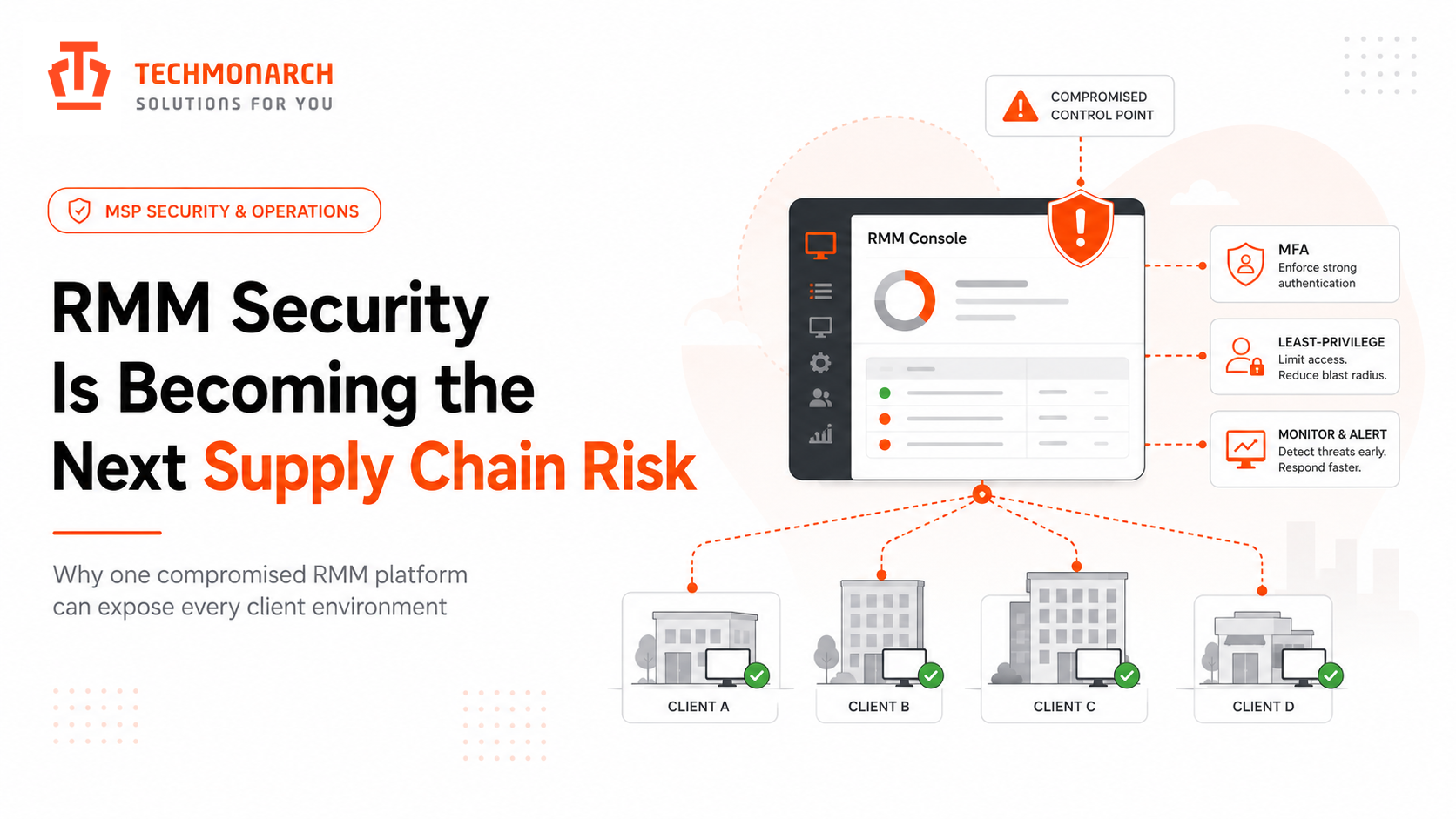
RMM tools are the operational nervous system of a managed services practice. They provide persistent, privileged access to every endpoint under management across every client environment. That access is exactly what makes them indispensable to MSPs, and exactly what makes them the most attractive single point of compromise available to an attacker targeting the managed services ecosystem. Compromising one RMM instance does not yield one victim. It yields every client the MSP manages — potentially dozens or hundreds of organizations, all reachable through a single authenticated session.
The threat intelligence community has been tracking this pattern with increasing urgency. What changed in the past two years is not the theory — it is the execution. Threat actors have moved from opportunistic exploitation of RMM vulnerabilities to deliberate, systematic targeting of MSP infrastructure as a preferred supply chain entry point. If you manage client environments through an RMM platform and you have not pressure-tested your RMM security posture specifically, the question is not whether your exposure exists. It is how visible it is.
The Kaseya Moment and What Came After
The 2021 Kaseya VSA supply chain attack remains the most well-documented illustration of RMM-as-attack-vector at scale. The incident exploited an authentication bypass and arbitrary code execution vulnerability in Kaseya’s on-premises VSA product. Through that single vulnerability, attackers pushed ransomware payloads to the endpoints managed by approximately 50 to 60 MSPs, affecting well over 1,000 downstream client organizations. The blast radius was a function of how RMM tools work: push a command to the platform and it executes across the entire managed client base.
Four years later, the pattern is more sophisticated but structurally identical. Huntress’s 2025 Cyber Threat Report documented that RMM abuse accounted for 6.5 percent of the most significant threat categories observed in 2024. In a separate incident series catalogued by the same research team, a single compromised MSP RMM instance was used to access three downstream client environments before detection and containment occurred. The Bomgar (now BeyondTrust) exploitation surge in early 2026 demonstrated the same dynamic: one compromised MSP platform, dozens of affected downstream businesses across multiple organizations. One analyst described the access implications clearly — compromising the server running the RMM appliance is effectively obtaining the key to every downstream environment simultaneously.
What makes this threat profile particularly challenging is that the attacker’s post-compromise activity is extremely difficult to distinguish from legitimate MSP operations. When a technician pushes a script through an RMM platform, that is normal behavior. When an attacker does the same thing through a compromised RMM session, the action looks identical to monitoring systems that are not specifically configured to detect behavioral anomalies in RMM activity patterns.
The Vulnerability Surface MSPs Are Not Fully Accounting For
RMM platform vulnerabilities represent one attack surface — but they are not the primary one. Most successful RMM compromises do not involve novel zero-day exploits in the RMM software itself. They exploit the much larger and more accessible vulnerability surface surrounding how MSPs configure, access, and govern their RMM deployments.
The most common initial access vector is credential compromise. Phishing campaigns targeting MSP administrative accounts, credential stuffing against RMM portals that do not enforce multi-factor authentication, and the re-use of credentials across platforms all provide a path to RMM access that bypasses any vulnerability in the software itself. The Verizon 2025 Data Breach Investigations Report found that credential abuse was the leading initial access vector in nearly a quarter of all analyzed breaches. In an MSP context, a compromised credential for an RMM administrator account is not a single-victim breach — it is an MSP-wide compromise event.
A second underappreciated surface is the access governance model most MSPs apply to their RMM platforms. Technician accounts in many MSP environments carry broader permissions than their daily work requires. A Tier 1 technician supporting a client environment may have access to RMM agent management functions, script execution capabilities, or cross-client visibility that is unnecessary for their assigned responsibilities. When that account is phished or compromised through credential stuffing, the attacker inherits all of it. The SimpleHelp vulnerabilities disclosed in early 2025 exploited precisely this pattern — low-privilege technician accounts could be used to escalate to server administrator roles through an API key generation flaw, because permission boundaries between technician roles were insufficiently enforced at the platform level.
The third surface is patch velocity. CISA advisory data indicates that exploitation of known remote access vulnerabilities can occur within nine to thirteen days of public disclosure. Most MSP RMM patching cycles operate on monthly or quarterly schedules — a window that is several times wider than the real-world exploitation timeline for actively targeted vulnerabilities. The gap between disclosure and patch deployment is where supply chain compromises most frequently originate.

Why the Supply Chain Framing Matters Operationally
MSPs have traditionally framed their security responsibilities in two directions: inward, toward protecting their own internal infrastructure, and outward, toward protecting client environments. RMM security occupies a third position that neither framing fully captures — it is the interface layer between the two, and its compromise produces downstream consequences at a scale that neither a pure internal breach nor a pure client breach would generate.
The supply chain framing matters because it changes how you think about both the threat model and the remediation priorities. A supply chain attack is not contained by perimeter defenses. The attacker does not need to defeat the security controls in each client environment individually. They defeat the trusted relationship between the MSP and those environments — specifically the trust that client systems extend to commands and connections originating from the RMM platform. Once that trust is exploited, the attacker moves laterally through client environments with the implicit authorization that the MSP’s operational footprint provides.
This also means that the blast radius of an RMM compromise is not proportional to the attacker’s sophistication — it is proportional to the MSP’s client count and the depth of access the RMM platform holds across those environments. A relatively unsophisticated attacker with a compromised RMM credential for a mid-size MSP has more potential reach than a highly sophisticated attacker targeting a single enterprise. That asymmetry is precisely what makes MSP RMM infrastructure so attractive as a supply chain entry point.
The Hardening Priorities That Actually Reduce Exposure
CISA’s joint advisory on protecting MSPs and their customers, produced in coordination with cybersecurity agencies from the UK, Australia, Canada, and New Zealand, establishes a clear baseline. It is not a comprehensive security framework — it is a minimum viable hardening posture for MSPs operating RMM and similar privileged access tools. Most of the priority controls are well understood in theory and inconsistently implemented in practice.
Multi-factor authentication for all RMM administrative accounts is the single highest-impact control. It does not eliminate the credential compromise risk, but it substantially raises the cost of exploitation for the most common attack vectors. Phishing-resistant MFA — hardware security keys or FIDO2-based authentication — is specifically recommended by NSA and CISA for privileged accounts and remote administrative sessions. Push-notification MFA remains vulnerable to fatigue attacks, where repeated approval prompts wear down users into confirming a fraudulent session. For RMM access specifically, convenience-based MFA is a meaningful risk reduction measure; phishing-resistant MFA is an actual control.
Least-privilege access governance within the RMM platform is the second priority. Technician accounts should carry only the permissions required for their specific assigned responsibilities. Cross-client visibility, script execution, and agent management should be scoped to roles that legitimately require those capabilities. This is less about preventing a determined attacker with administrator credentials and more about containing the damage from compromised mid-tier accounts — which represent a far more common scenario than administrator compromise in real-world incident data.
Session monitoring and behavioral anomaly detection specifically for RMM activity rounds out the baseline. Standard network monitoring and endpoint detection tools are not well-calibrated to detect malicious activity executing through RMM channels, because that activity resembles legitimate technician operations. Dedicated monitoring that establishes behavioral baselines for RMM activity — typical session durations, common script types, usual target client populations for individual technicians — and flags deviations from those baselines provides detection coverage in the gap that standard tools do not fill.
The Vendor Risk Dimension
MSP RMM security is not purely an internal governance problem. The RMM platform itself is a vendor relationship, and like any vendor relationship involving privileged access to critical infrastructure, it carries third-party risk that deserves active management rather than passive trust.
The questions MSPs should be putting to RMM vendors — and reviewing contractually — include patch release cadences and notification timelines for security vulnerabilities, the vendor’s own security posture and penetration testing practices, the availability of audit logs and session recording at the platform level, and the vendor’s incident response obligations when a platform-level vulnerability is discovered and exploited. For cloud-hosted RMM platforms specifically, the vendor’s data isolation practices between MSP tenants are relevant — a platform architecture that allows one compromised MSP tenant to observe or influence another represents a different risk profile than a fully isolated multi-tenant model.
These conversations are uncomfortable in vendor relationships where the MSP is a relatively small customer with limited negotiating leverage. They are still worth having, both for the intelligence value of the vendor’s responses and because asking them demonstrates to the vendor that their MSP customer base is paying attention to platform security — which is a form of market pressure that does influence product development priorities over time.
How NOC and SOC Integration Changes the Risk Equation
For MSPs that leverage white-label NOC and SOC services, the RMM security question extends to the operational interface between the MSP and its service partners. A white-label NOC that accesses client environments through the MSP’s RMM platform represents an additional identity and access management challenge: those NOC technicians need sufficient access to perform their monitoring and response functions, but their access should be scoped and governed with the same rigor applied to internal MSP accounts.
The maturity level of a white-label partner’s own internal security practices is therefore a legitimate selection criterion — not a secondary concern. MSPs should understand what access their NOC partner holds within the RMM environment, how that access is authenticated and logged, and what the partner’s incident response obligations are in the event of a credential compromise on their end. Providers like Techmonarch operate with defined access governance frameworks specifically because the alternative — broad, ungoverned RMM access across multiple MSP clients — creates exactly the blast radius problem that makes RMM-based supply chain attacks so impactful.
The goal is not zero access for partner teams — that defeats the operational purpose of the engagement. The goal is documented, auditable, minimum-necessary access that is reviewed regularly and revoked cleanly when engagements change. Applied consistently, that posture reduces the exposure surface without degrading the operational capability the partnership is designed to provide.
A Risk That Compounds With Scale
The uncomfortable reality of RMM as a supply chain risk vector is that the exposure grows as the MSP grows. A practice managing 20 clients through an RMM platform is an attractive target. A practice managing 200 clients is exponentially more attractive, because the same compromise yields ten times the downstream access. Security posture improvements that were adequate at smaller scale do not automatically scale with the business.
The MSPs best positioned to manage this risk are those that treat RMM security as a distinct operational discipline — not a subset of general endpoint security or network perimeter management. That means dedicated access governance reviews, RMM-specific behavioral monitoring, aggressive patch timelines for platform components, and vendor risk assessments that go beyond the initial procurement evaluation. It also means building RMM security requirements into the operational standards that govern any partner relationship touching client environments.
The supply chain framing, applied honestly, produces a useful question: if your RMM platform were fully compromised tomorrow, what would the blast radius actually look like across your client base, and how quickly would you detect it? The answer to that question, worked through in advance rather than reconstructed after an incident, reveals the specific controls worth prioritizing.
Recent Comments
- No comments to show