
-
Vijit
- June 11, 2026
- No categories assigned.
- No Comments
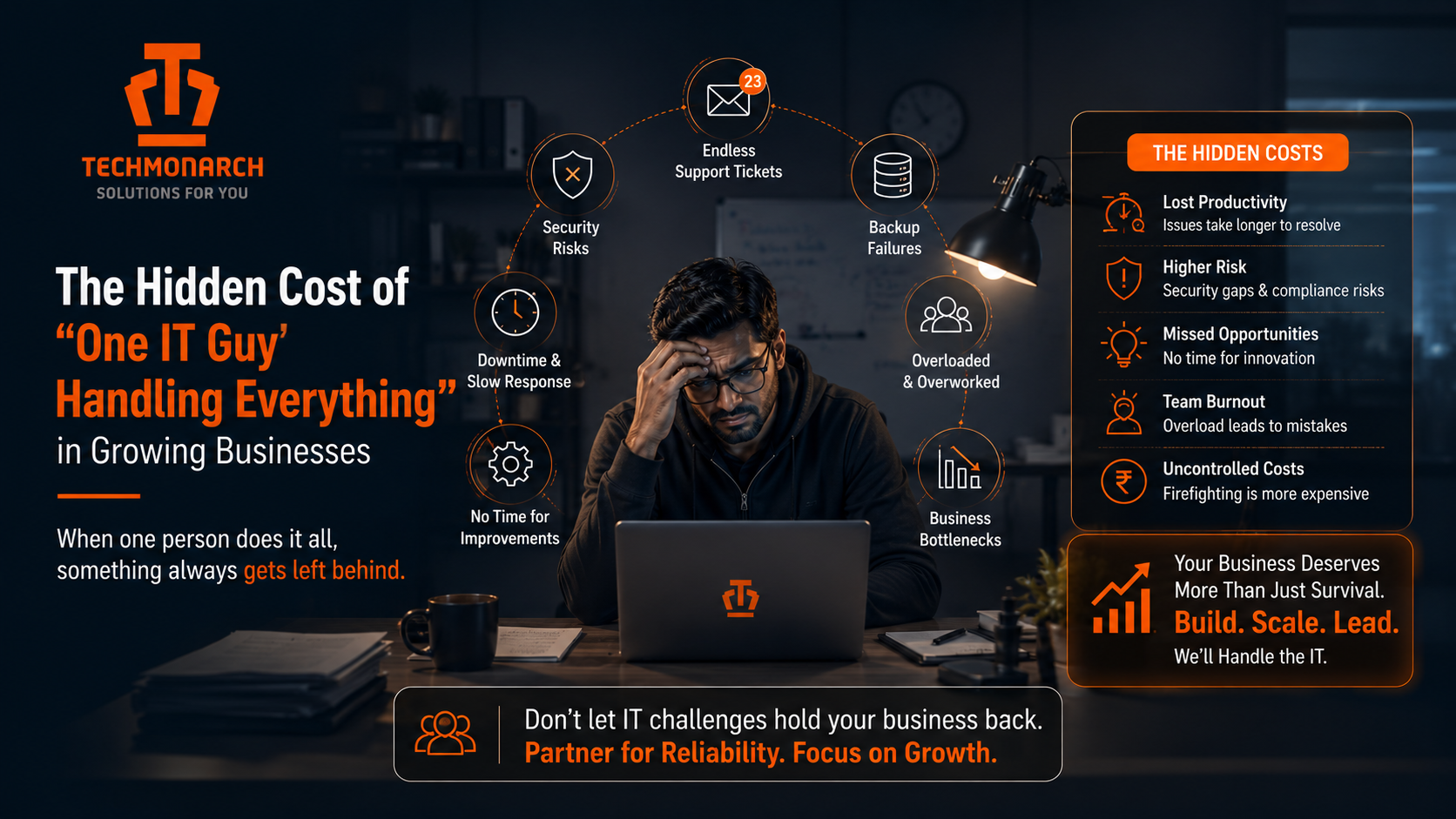
Every growing business has a version of this story. In the early days, there was one person who knew everything about the company’s technology. They set up the office network, configured the email, chose the accounting software, kept the laptops running, and somewhere along the way became the unofficial custodian of every password, every vendor contract, and every workaround ever built into the system.
For a while, it works. Remarkably well, actually. This person is capable, resourceful, and genuinely invested in keeping things running. But as the business grows, something starts to shift. The systems multiply. The staff headcount climbs. The complexity of the IT environment compounds quietly in the background. And that one person, still doing everything, starts carrying a weight the original setup was never designed to hold.
The costs of this arrangement rarely show up on a balance sheet. They accumulate in subtler places: in the projects that never quite get started, in the risks that nobody has time to address, in the slowdowns that everyone has learned to quietly accept. This piece is about those costs, and about why the “one IT guy handling everything” model has a growth ceiling that most businesses hit before they realise what’s happening.
The Bandwidth Problem Nobody Talks About
A single IT professional, no matter how skilled, has a fixed number of hours in a week. What fills those hours matters enormously. In a small, stable organisation, the split between reactive and proactive work is manageable. But as a business scales, the reactive side of IT expands almost automatically: more users mean more support tickets, more devices mean more patch cycles, more software means more integrations that occasionally break.
The problem is that proactive work, which is the type that actually protects and advances the business, gets squeezed first. Security reviews slip. Infrastructure planning gets deferred. Backup integrity checks happen only when someone thinks to ask. Vendor renewals get handled reactively when the contract is already expiring rather than strategically, when there’s still time to negotiate.
The irony is that the more overwhelmed this person becomes, the more indispensable they appear. They’re always busy. They’re always needed. And because they’re always in demand, there’s rarely a moment to step back and ask whether the overall model is sustainable, or safe.
The Key Person Risk That Most Companies Underestimate
There is a specific category of business risk called key person dependency, and IT is where it tends to be most acute. When one individual is the sole custodian of how your systems are configured, where your data lives, what your passwords are, why your firewall is set up the way it is, and which vendor to call when something specific breaks, the entire technical foundation of your business rests on that person’s continued availability.
Consider what actually happens in any of these scenarios: that person takes an extended leave, resigns with two weeks’ notice, gets sick for a month, or simply burns out and becomes significantly less effective. The organisation doesn’t just lose one employee. It loses access to a body of knowledge that was never formally documented, was never transferred, and now exists partly in someone’s head and partly scattered across systems that nobody else fully understands.
The recovery from this kind of disruption is expensive and slow. Vendors have to be contacted one by one to transfer account ownership. Configuration decisions that made sense at the time have to be reverse-engineered. Processes that were informal and verbal have to be rebuilt from scratch. The average cost of replacing a technical employee, including the knowledge gap period, runs significantly higher than most business owners expect when they haven’t planned for it.
There is also a more insidious version of this risk, one that unfolds not through departure but through stagnation. When one person is responsible for every IT decision, that person’s preferences, blind spots, and bandwidth constraints become the ceiling for everything the organisation can do with technology. Innovation stagnates not because the business lacks ambition, but because the person holding it all together simply does not have the capacity to think beyond keeping everything running.
The Security Gap That Grows Quietly
Security is where the single-IT-person model shows its most serious structural weakness. Effective cybersecurity is not a project; it is a continuous operational discipline. Threats evolve constantly, patches need to be applied within days of release, and monitoring needs to be active around the clock, not just during business hours.
One person working standard hours, juggling helpdesk requests alongside infrastructure maintenance and the dozen other things on their plate, cannot maintain the kind of security posture that modern businesses actually require. Patches get delayed because there’s a more pressing issue. Monitoring alerts go unreviewed because the inbox is full. Security audits get scheduled and then repeatedly pushed back because there’s always something more urgent.
The result is not dramatic or sudden. It is a slow accumulation of small gaps, none of which individually looks catastrophic, but which collectively represent a meaningful and growing exposure. Businesses running this way tend to find out about their security posture at exactly the wrong moment: during a ransomware incident, after a data breach, or in the middle of a compliance audit.
The Strategic Cost: When IT Can’t Lead
There is a role that IT leadership is supposed to play in growing organisations: translating business objectives into technology decisions, identifying where investment in infrastructure will create competitive leverage, and guiding the company toward tools and platforms that will scale with growth rather than against it. This is genuinely valuable work, and it requires time, mental clarity, and access to current industry knowledge.
When one person is buried under the day-to-day operational load, none of that happens. The IT function becomes, by necessity, reactive and tactical rather than proactive and strategic. The business ends up making major technology decisions, including platform choices, vendor commitments, and infrastructure investments, without the kind of informed guidance those decisions deserve.
This cost is hard to quantify precisely, but it shows up in recognisable ways: a cloud migration that goes over budget because it wasn’t planned properly, a software rollout that creates more problems than it solves because due diligence was rushed, or an infrastructure investment that becomes obsolete faster than expected because nobody had time to think three years ahead.
What the Right Structure Actually Looks Like
Addressing the single-IT-person problem does not necessarily mean hiring a full department. For most mid-sized businesses, the most practical path is a hybrid model: one or two internal IT professionals who own strategy, vendor relationships, and institutional knowledge, supported by an external managed IT partner who handles the operational load.
The external partner typically absorbs:
- 24/7 monitoring and alert management, including outside business hours
- Patch management across all endpoints, servers, and business applications
- Helpdesk support for standard end-user issues and first-line triage
- Backup execution, verification, and disaster recovery preparedness
- Security monitoring, vulnerability scanning, and compliance reporting
This division of labour solves the bandwidth problem without requiring the business to build an internal team from scratch. The internal IT person or small team gains back a significant portion of their time, the security posture gets genuine round-the-clock attention, and the knowledge that is unique to the organisation stays exactly where it should: inside the company.
For businesses in Gujarat that are navigating this transition, it is also worth thinking about what “staff augmentation” can do alongside managed services. Rather than filling every gap with a full-time hire, augmented IT roles can address specific functional shortfalls, such as infrastructure planning or security oversight, without the overhead of permanent headcount. Providers like Techmonarch structure their engagements to support both models, working alongside existing IT personnel rather than replacing them.
Documentation: The Thing That Makes Everything Else Possible
One of the less-discussed costs of the single-IT-person model is the documentation deficit it tends to create. When one person handles everything, documentation feels redundant; they already know how everything works. But that institutional knowledge, residing entirely in one person’s memory, is one of the most fragile assets a business can have.
Proper IT documentation covers network architecture, system configurations, vendor contacts, software inventories, access management procedures, and recovery processes. In its absence, every new hire takes longer to onboard, every handoff to an external partner requires a painful discovery phase, and every incident takes longer to resolve because nobody can find the relevant context quickly.
Any serious move toward a more sustainable IT model should include, as a non-negotiable first step, getting the organisation’s critical IT knowledge out of one person’s head and into written form. This benefits the business regardless of what structural changes follow, and it is also the foundation that makes any external partnership actually work.
Recognising the Ceiling Before You Hit It
Most businesses do not realise they have outgrown their IT model until something breaks badly enough to force the conversation. A security incident, a sudden staff departure, a failed audit, or an infrastructure failure that takes far longer to recover from than it should. These events are painful, expensive, and in most cases, entirely predictable.
The more useful approach is to do the diagnostic before the crisis. Ask your IT person honestly how much of their week is spent on reactive, operational work versus forward-looking, strategic work. Ask what happens if they are unavailable for two weeks. Ask when the last time was that anyone reviewed the security posture in a structured way, or ran a proper disaster recovery test.
If those questions produce uncomfortable answers, the cost of the current model is already higher than it appears. The one-IT-person setup served the business well at the scale it was designed for. But a growing company deserves an IT function that can actually grow with it: one where the operational load is managed sustainably, the security posture is maintained continuously, and the people with the deepest knowledge of the business are free to apply it strategically rather than spending it on tasks a well-structured system would handle automatically.
Recent Posts
- Why IT Vendors in Ahmedabad Take Days to Respond — And What "Managed" Should Actually Mean
- Why More Ahmedabad Companies Are Switching From Freelance IT Support to Managed Partners
- What Ahmedabad Businesses Get Wrong About IT Compliance Under India's DPDP Act
- A Look Inside How We Manage IT Infrastructure for Ahmedabad Businesses Across Industries
- Why Gandhinagar's Growing IT/ITES Sector Needs Local Managed Support, Not Remote-Only Vendors
Recent Comments
- No comments to show