
-
Vijit
- August 27, 2026
- No categories assigned.
- No Comments
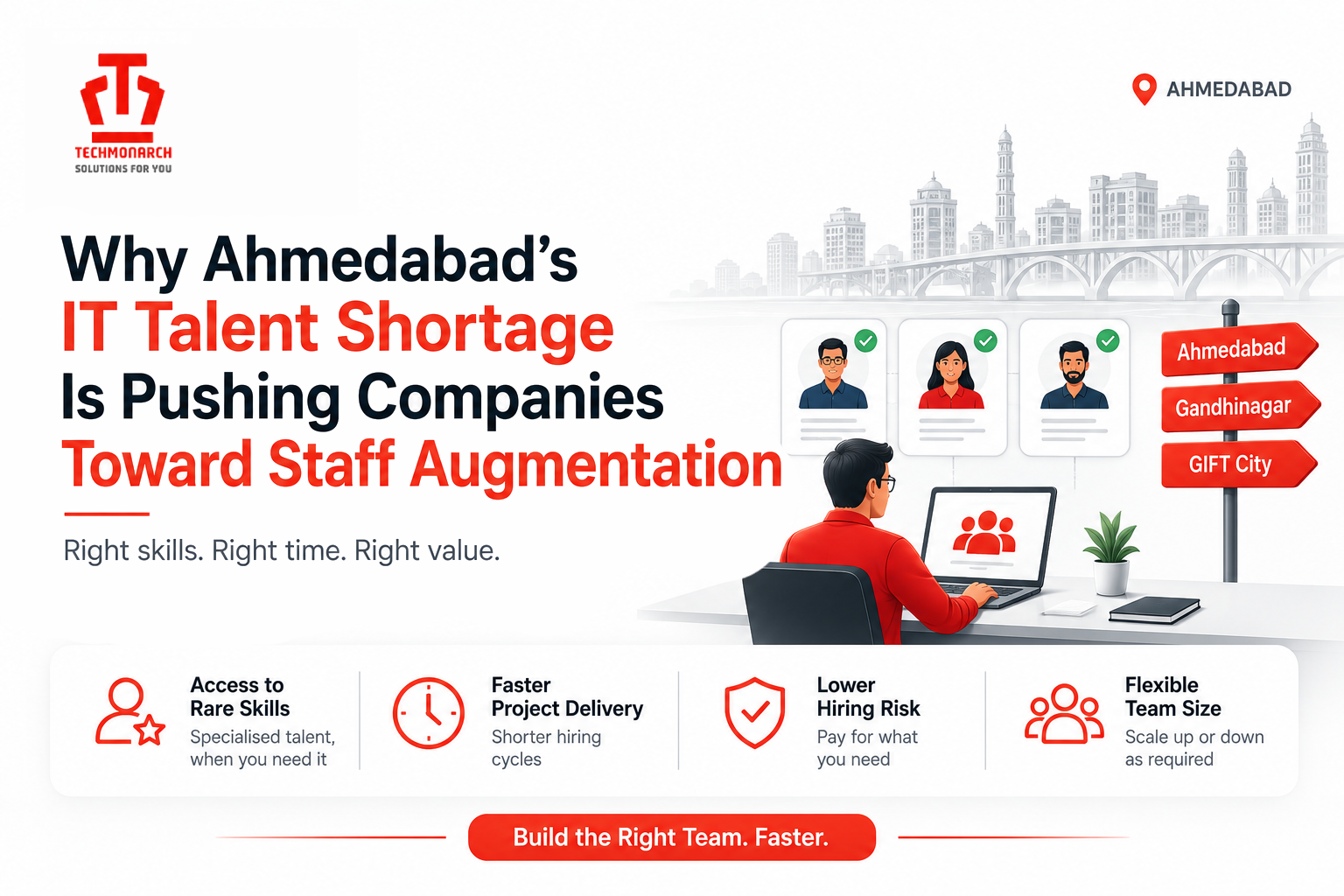
Why Ahmedabad’s IT Talent Shortage Is Pushing Companies Toward Staff Augmentation
Talk to almost any IT manager or founder in Ahmedabad right now and the conversation eventually lands on the same problem: finding good people is taking longer, costing more, and the candidates who do show up aren’t always the ones you actually need. This isn’t a perception issue. It’s a fairly direct result of how fast the city’s IT and GCC scene has grown over the last two or three years, and it’s changing how a lot of companies here think about hiring altogether.
We work with enough IT teams across Ahmedabad and Gandhinagar to see this pattern repeat itself, so it’s worth unpacking why it’s happening and why staff augmentation has quietly become the go-to answer for a lot of companies, rather than just another buzzword floating around HR circles.
The growth is real, and it’s outpacing the talent pipeline
GIFT City, the SEZ towers along SG Highway, and the newer tech townships coming up near Ahmedabad have pulled in a genuinely large number of GCCs, IT services firms, and captive centres over a short span. That’s good news for the city’s economy, but it also means a lot of companies are hiring for the same roles at the same time, out of the same, still-maturing local talent pool. Colleges and training institutes haven’t scaled output at the same pace as office space has, so the demand curve for skilled IT professionals moved faster than the supply curve.
The result is what you’d expect. Roles that used to take three or four weeks to fill are now taking two months or more, particularly anything involving cloud infrastructure, DevOps, cybersecurity, or specialised enterprise systems. Entry-level hiring is still relatively manageable. It’s the mid-to-senior, specialised roles where things get genuinely difficult.
Bengaluru, Pune, and remote work are quietly pulling from the same pool
Ahmedabad’s cost of living and quality of life are real advantages, and they show up in recruitment conversations often enough. But a sizeable chunk of the city’s more experienced IT talent still has one eye on Bengaluru, Pune, or a remote role for a company headquartered somewhere else entirely. Remote work in particular has made geography far less relevant than it used to be. A senior systems engineer in Ahmedabad can just as easily work for a company in another city or country without relocating, which means local employers aren’t only competing with each other anymore. They’re competing with every remote-friendly employer in the country.
This shows up most sharply for niche and emerging skill sets. Specialists in areas like cloud security, automation, or newer AI-adjacent tooling are scarce everywhere, and when the pool is already small, a handful of aggressive remote offers can pull half of it away from the local market within a few months.
Hiring the traditional way has gotten slower and riskier
The usual playbook, post a job, screen resumes, interview, negotiate, onboard, hasn’t gone away, but it’s become a slower and less predictable process than it used to be. Good candidates are fielding multiple offers and often disappear mid-process. Salary expectations have moved up faster than a lot of internal budgets have adjusted to, which means offers get renegotiated or candidates walk. And for a company that suddenly needs a specific skill set for a three or six month project, going through a full recruitment cycle for what might be a temporary need rarely makes financial sense in the first place.
This is exactly the gap staff augmentation fills. Instead of committing to a full-time hire for a need that might shift in six months, or spending two months trying to fill a role that’s blocking a project right now, companies bring in vetted IT professionals on a flexible basis, for exactly as long as the work requires. It’s not a replacement for a core in-house team. It’s a way to keep projects moving without taking on hiring risk that doesn’t match the actual need.
Why it’s specifically catching on in Ahmedabad right now
A few things are converging here at the same time. Companies are scaling infrastructure and digital projects faster than their internal teams can keep up with, hiring timelines have stretched out, and a lot of businesses, especially mid-sized ones, are still cautious about growing permanent headcount too quickly after a couple of unpredictable years. Staff augmentation sits neatly in that gap. It gives a company access to specific, sometimes hard-to-find skills, without the long hiring cycle or the long-term commitment, and without the overhead of managing an outsourced project team that doesn’t sit inside your own workflows.
At Techmonarch, this is one of the more frequent conversations we have with IT managers and business owners across the city. Someone needs a network engineer for a three-month infrastructure rollout, or a helpdesk technician to cover a busy season, or a specialist for a migration project that doesn’t justify a permanent role. Staff augmentation lets that person slot into the existing team, working under the company’s own processes and reporting lines, without the company having to run a full recruitment cycle for something that isn’t a permanent need.
What to actually look for before going down this route
Not every staffing partner is equally useful here, and it’s worth being a little deliberate about it. The value of staff augmentation depends heavily on how well the person actually integrates with your team, not just whether they have the right skills on paper. It’s worth asking a potential partner how quickly they can actually place someone, not just how large their database is. Ask how candidates are vetted technically, not just for résumé keywords. And ask what happens if the person isn’t a good fit a few weeks in, because that flexibility is a big part of why this model works in the first place.
It’s also worth being clear internally about whether a role is genuinely temporary or whether it’s really a permanent need dressed up as a short-term one. Staff augmentation works best when the scope is honest. Using it to quietly avoid ever making a permanent hire for a role that clearly needs one tends to backfire in the form of inconsistent delivery and knowledge that walks out the door with the contractor.
There’s also a cultural fit question that’s easy to overlook. An augmented team member still has to work inside your reporting structure, your ticketing system, and your team’s usual way of communicating. A staffing partner who understands that, and briefs their people accordingly before day one, tends to save you weeks of onboarding friction compared to one who simply hands over a resume and a start date.
Where this is heading
The talent gap in Ahmedabad’s IT sector isn’t likely to close on its own anytime soon. More business parks are opening, more GCCs are setting up here, and training pipelines take years to catch up with demand that’s already here. Companies that build some flexibility into how they staff IT work, rather than relying entirely on traditional hiring, are simply going to have an easier time keeping projects on schedule over the next few years. For a lot of businesses in the city, staff augmentation has stopped being a stopgap and started being a fairly normal part of how IT teams actually get built.
Recent Posts
- IT Staff Augmentation in Ahmedabad: A Guide for CEOs Hiring Their First Outsourced Engineer
- Why Ahmedabad's IT Talent Shortage Is Pushing Companies Toward Staff Augmentation
- Setting Up IT Infrastructure in Ahmedabad's New Business Parks: What Nobody Tells You Upfront
- Why GIFT City and Gandhinagar Companies Need a Different IT Infrastructure Approach Than Ahmedabad Offices
- Managed IT Services in Ahmedabad: What Local SMBs Pay vs. What They Actually Need
Recent Comments
- No comments to show