
-
Vijit
- August 20, 2026
- No categories assigned.
- No Comments
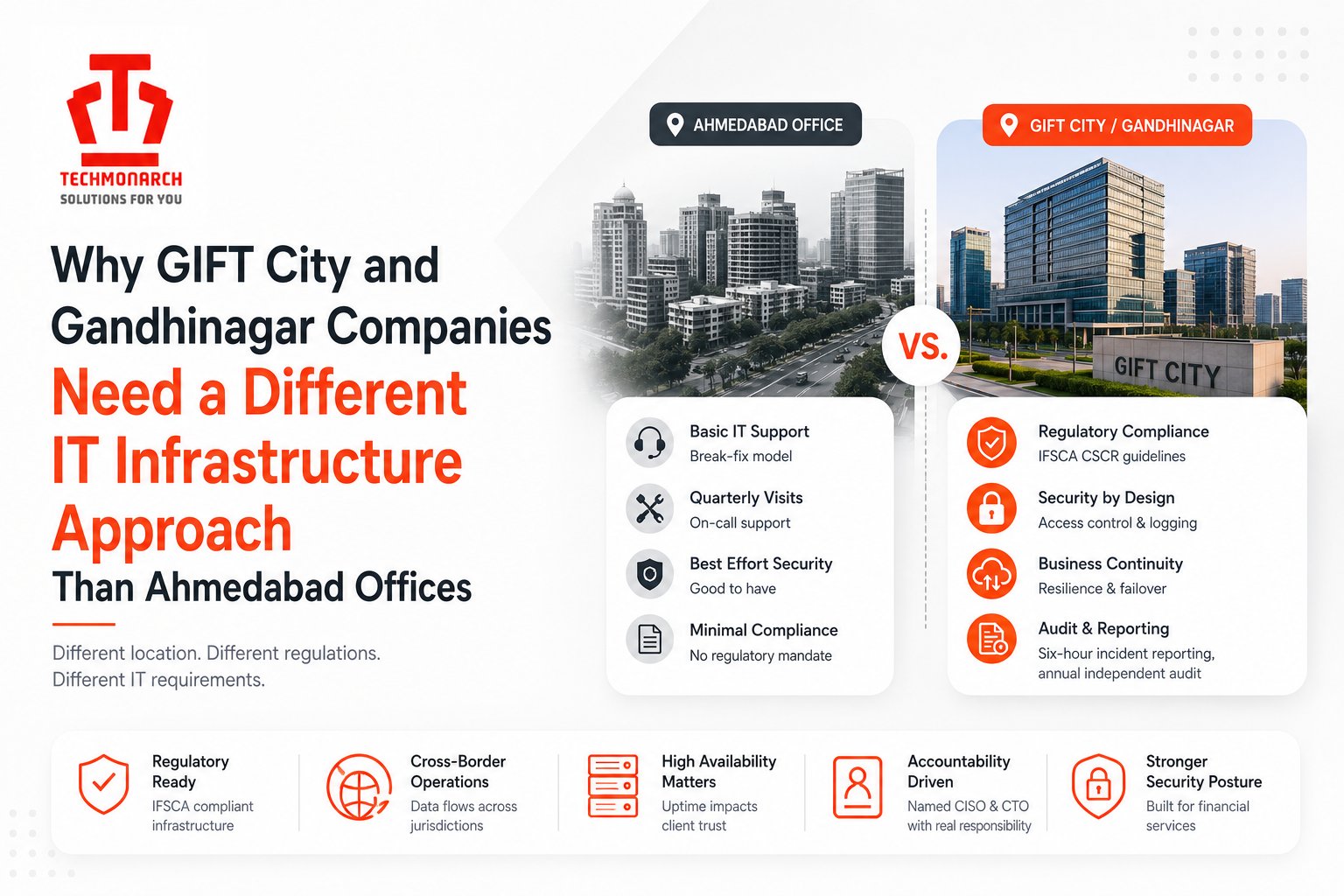
Why GIFT City and Gandhinagar Companies Need a Different IT Infrastructure Approach Than Ahmedabad Offices
Two founders set up shop in the same month. One leases an office off SG Highway in Ahmedabad and runs a trading business. The other opens a small fund management unit in GIFT City, fifteen minutes away by road. Both call around for “IT support” and expect roughly the same conversation — firewall, backup, a helpdesk number to call when something breaks. The GIFT City founder finds out within a few weeks that this isn’t the same conversation at all. Not because the second office is bigger or more complex, but because of what the address itself now requires of them, on paper, whether they’ve read the fine print or not.
That distinction gets missed constantly, and it’s worth spelling out plainly, because it changes what “good IT” even means depending on which side of Gandhinagar you’re sitting on.
The address comes with a regulator attached
An Ahmedabad SMB’s IT obligations are mostly self-imposed — sensible password policies, working antivirus, backups you can trust. Nobody audits a trading firm’s firewall configuration unless something goes badly wrong. A GIFT City entity regulated by the International Financial Services Centres Authority doesn’t have that luxury. IFSCA’s Cyber Security and Cyber Resilience Guidelines, in force since April 2025 and tightened further for market infrastructure institutions in 2026, require regulated entities to name a CISO and CTO with real accountability, maintain a documented cyber security framework, and report any incident to the regulator within six hours of detection — followed by an interim report in three days and a full root-cause report within thirty. An annual independent audit, carried out by a CERT-In empanelled auditor or someone holding a CISA, CISM, or CISSP certification, has to be filed within ninety days of the financial year closing.
None of that is optional best practice. It’s a compliance calendar with real deadlines, and it turns IT from a support function into something closer to a regulatory obligation with a technology component. A provider used to quarterly AMC visits for a city-side office has usually never built anything like this, because nothing in a standard Ahmedabad SMB engagement has ever required it.
Small doesn’t mean exempt — it means the obligation moves upstream
IFSCA does carve out some relief for very small entities and for Global In-House Centres — broadly, firms under ten employees and captive units of larger foreign parents. It’s tempting to read that as “we’re too small to worry about this.” The actual requirement is closer to the opposite: exempted entities still have to align with their parent company’s cyber security framework and report through it. In practice, a ten-person GIFT City unit of a London or Singapore asset manager inherits its parent’s security stack — SOC 2 controls, ISO 27001 certification requirements, specific logging and access standards — on top of whatever IFSCA expects locally. The compliance burden doesn’t disappear at small scale. It just arrives from a different direction, and somebody local still has to make the on-the-ground infrastructure match it.

Cross-border by design, not by accident
A GIFT City IFSC unit is treated as a person resident outside India under India’s foreign exchange regulations, built specifically to serve international clients and route cross-border financial activity. That status has a direct IT consequence: data genuinely moves across jurisdictions as a normal part of doing business, in a way it simply doesn’t for a domestic Ahmedabad trading company. Decisions that a city-side SMB rarely has to think about — where data is hosted, which jurisdiction’s privacy law applies to a given client record, how a parent entity’s data residency commitments interact with Indian requirements — become everyday design questions for a GIFT City network, not edge cases for a legal team to worry about once a year.
Access control stops being a convenience feature
A city-side Ahmedabad office typically treats access control as a nice-to-have — a swipe card system mostly there to keep the front door tidy. Inside a regulated GIFT City unit, who accessed which system, from where, and when is exactly the kind of question an auditor or an incident-response report will ask, and “we’re not entirely sure” is not an acceptable answer once a CISO’s name is attached to the framework. That pushes basic decisions — server room access logs, named accounts instead of shared logins, retention periods for surveillance footage — from an afterthought into something a network design has to account for from day one, not bolted on once someone asks for evidence.
World-class campus infrastructure isn’t the same as your network being ready
GIFT City’s own infrastructure is genuinely strong — underground utility ducting designed to avoid repeated road digging, fifteen major telecom operators present on campus, centralised monitoring of power and utilities. It’s a meaningfully different starting point from an office park on the Ahmedabad periphery, and it’s easy to assume that strength extends automatically into whatever a tenant builds inside their own four walls. It doesn’t. The campus gives you excellent options for connectivity and power; it doesn’t configure your firewall, segment your network, or decide whether your trading desk has a genuine failover circuit versus a single ISP link with a comforting SLA attached to it. Financial firms generally direct somewhere between 15 and 30 percent of their total IT budget toward resilience and business continuity specifically because an hour of downtime on a client-facing system carries a different order of consequence than an hour of downtime in a back office — that ratio has to be a deliberate design choice inside the tenant’s own network, not something the building provides by default.
What this means when you’re choosing who supports you
For an Ahmedabad SMB, a capable local IT partner is largely judged on responsiveness — how fast someone shows up, how well they know your setup. For a GIFT City entity, responsiveness still matters, but it sits underneath a longer list: can this provider produce the documentation an IFSCA audit will actually ask for; do they understand segregation of duties and access logging well enough to support a CISO who’s personally accountable for the answer; have they worked with a CERT-In empanelled auditor before, or would that be a first for them too. These aren’t questions a generalist AMC vendor is usually equipped to answer, and asking them late — after a regulator has already requested evidence — is a considerably worse time to find out. Techmonarch treats these as genuinely separate engagement types rather than the same service with a longer checklist, because the accountability structure underneath them is different, not just the paperwork on top.
Practical questions worth asking before you sign anything
If you’re setting up or already operating in GIFT City, it’s worth asking a prospective IT partner directly: can they document controls in the format an IFSCA-aligned audit expects, not just describe them informally? Do they understand how your parent entity’s framework — if you have one — is meant to interact with local requirements? What’s the actual failover path if your primary connectivity link goes down, tested rather than assumed? And who, specifically, picks up the phone within the six-hour reporting window if something does go wrong at 2 am?
For a city-side Ahmedabad office, most of that list simply doesn’t apply, and that’s fine — it’s a different kind of business with a different kind of risk. The mistake worth avoiding is assuming both offices need the same conversation just because they’re a short drive apart. They don’t, and the address on the lease is usually the first clue.
Recent Posts
- IT Staff Augmentation in Ahmedabad: A Guide for CEOs Hiring Their First Outsourced Engineer
- Why Ahmedabad's IT Talent Shortage Is Pushing Companies Toward Staff Augmentation
- Setting Up IT Infrastructure in Ahmedabad's New Business Parks: What Nobody Tells You Upfront
- Why GIFT City and Gandhinagar Companies Need a Different IT Infrastructure Approach Than Ahmedabad Offices
- Managed IT Services in Ahmedabad: What Local SMBs Pay vs. What They Actually Need
Recent Comments
- No comments to show