
-
Vijit
- June 25, 2026
- No categories assigned.
- No Comments
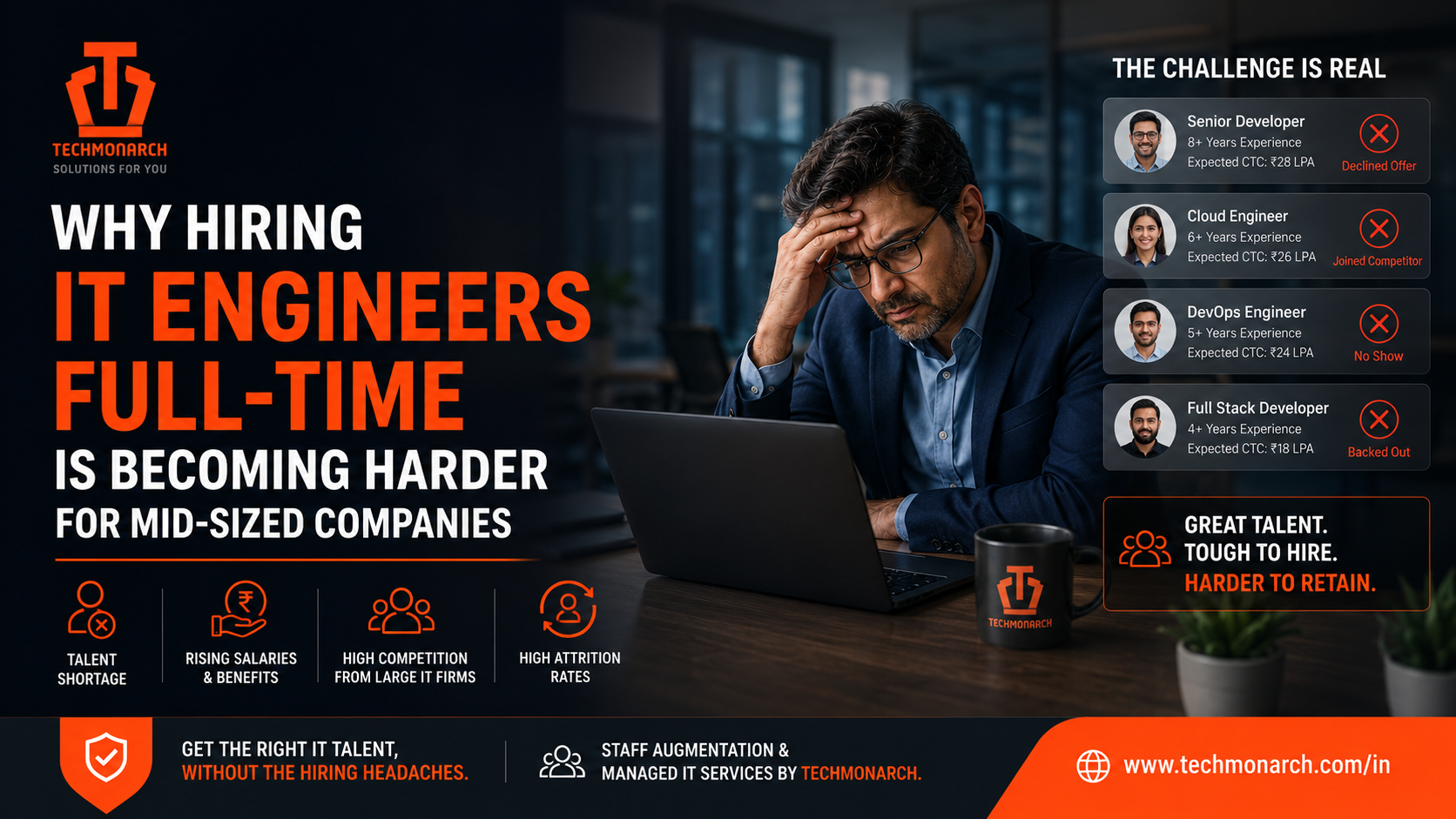
There is a quiet frustration building inside many mid-sized companies right now, and it has nothing to do with strategy or leadership. It is about a much more immediate problem: the inability to hire and hold onto qualified IT engineers at a pace that keeps up with the business’s actual needs.
This is not a new problem, but it has intensified considerably. The talent market for skilled IT professionals has shifted in ways that disproportionately disadvantage companies sitting in the 50-to-500 employee range. They are large enough to have real, complex IT requirements — cloud infrastructure, cybersecurity, network engineering, systems integration — but not large enough to compete on the terms that the market now demands. And the gap between what they need and what they can realistically hire keeps widening.
This article is an honest look at why that is happening, what the structural forces are, and what options mid-sized organizations actually have. It is written for IT managers and business leaders who are tired of reading job market think-pieces and want to understand the mechanics of the problem well enough to make better decisions.
The Numbers Behind the Shortage
The global IT talent shortage is not a soft trend; it has hard numbers attached to it. The International Data Corporation projects that over 90 percent of organizations worldwide will face IT skills shortage challenges by 2026, with the cumulative cost of unfilled technical roles estimated at $5.5 trillion in delayed or lost output. The US Bureau of Labor Statistics forecasts software developer employment growing at roughly twice the average rate of all other occupations through 2034. Meanwhile, educational institutions and training programs have not kept pace with that rate of demand growth — they are producing graduates at the same speed the industry would have needed five years ago.
The average time to fill a senior technical role has extended significantly. Across markets, SHRM data indicates an average time-to-hire for technical roles of 30 to 66 days, roughly 50 percent longer than non-technical positions. For specialized roles — cloud architects, cybersecurity engineers, DevOps specialists — the realistic timeline is often longer. During that vacancy window, projects stall, existing team members absorb extra load, and the opportunity cost accumulates silently.
The paradox that confuses many HR leaders: these shortages are happening simultaneously with reported tech layoffs at large companies. The explanation is that the layoffs have been concentrated in areas like marketing, recruiting, and operational support, while the demand for engineering talent — particularly in cloud, security, and AI-adjacent roles — has continued to grow. The supply of software engineers in the traditional sense has not changed materially; the demand has simply shifted toward a narrower, higher-skill profile that takes longer to produce and longer to hire.
Why Mid-Sized Companies Are in the Hardest Position
The IT talent market has a hierarchy, and mid-sized companies sit in an uncomfortable middle tier. At the top, large technology firms and multinationals compete with compensation packages — base salary, equity, career trajectory, prestige, and cutting-edge technology exposure — that most mid-sized organizations cannot match. At the other end, very small companies can sometimes attract talent through equity upside, flat structure, or the appeal of foundational impact.
Mid-sized companies offer neither extreme. They cannot match the cash and career-development infrastructure of large employers, and they often cannot offer the equity upside or greenfield opportunity of an early-stage startup. The result is that they are competing for a narrowed pool of candidates — those who specifically value stability, meaningful work without startup-level chaos, or a local presence — while facing the same market-rate salary expectations as everyone else.
The salary reality is stark. The median US technology salary crossed $112,000 in 2024, more than double the national median for all occupations. For senior engineers in specialized areas, the expectations are significantly higher. A mid-sized company in a regional market trying to hire a cloud security engineer or a senior network architect is often looking at compensation demands that were simply not part of the budget model when the position was planned.
And salary is only the most visible dimension of the competitive gap. The full cost of a competitive full-time hire includes benefits, employer contributions, onboarding time, hardware provisioning, management overhead, and the hidden cost of productivity ramp-up — the period during which a new hire is consuming organizational resources without yet delivering full output. That ramp-up period for senior technical roles is typically measured in months, not weeks.
The Retention Problem That Follows the Hiring Problem
Hiring is only the first challenge. Retention is where many mid-sized companies discover the second, related problem: the engineers they successfully attract continue to be recruited, aggressively and continuously, by organizations with stronger offers.
The data on this is consistent across studies. Over 90 percent of Gen Z tech workers under 25 reported in a survey by global tech recruitment firm Lorien that they would consider new opportunities within the next year. ManpowerGroup’s 2024 Global Talent Shortage survey found that 75 percent of employers globally report difficulty finding the skilled talent they need — and a significant part of that difficulty is driven not by an inability to hire but by an inability to retain long enough to build genuine team capability.
The retention problem for mid-sized IT teams has a specific and underappreciated dimension: the technology environment itself. Engineers want to work on current, interesting, well-maintained infrastructure. When the internal IT environment is dominated by legacy systems, underdocumented configurations, and tools that feel dated, that becomes a retention risk independent of compensation. The quality of what an engineer is asked to work on matters to them — often as much as what they are paid to do it.
This is a reinforcing cycle that is hard to escape without addressing it deliberately. The company cannot attract the engineers it needs to modernize the environment. The environment stays dated because modernization requires engineers. And the dated environment repels the engineers the company is trying to hire. Breaking that cycle requires external capability — either to modernize the environment directly, or to provide interim coverage while an internal team is stabilized.
What the Skill Concentration Problem Looks Like in Practice
Even companies that successfully hire skilled IT engineers tend to encounter a structural problem: the skills they need are concentrated in ways that are difficult to cover with a small full-time team.
A company of 150 people with a three-person IT team might have a network generalist, a systems administrator, and a helpdesk lead. That team handles the steady-state operational requirements adequately. But then the company needs to evaluate its cloud migration options, or experiences a security incident, or wins a client that requires a specific compliance certification. Suddenly the team needs expertise in cloud architecture, incident response, or compliance frameworks — skills that may not exist anywhere in the current headcount.
Hiring a cloud architect or a cybersecurity specialist for what might be a six-month project scope does not make economic sense as a full-time position. The role would be overpowered for the ongoing operational requirements and underutilized for most of the year. But the work still needs to be done, and it cannot be delegated to the existing team without either significant upskilling time or a serious quality compromise.
This is the skill concentration trap that mid-sized companies navigate repeatedly: the breadth of IT capability they need exceeds what any small, fixed team can reasonably provide, but the volume of work in any individual specialty does not justify a dedicated full-time hire. The business ends up either over-hiring (maintaining expensive specialists who are not fully utilized) or under-resourcing (asking generalists to handle work that requires specialist knowledge).
The Changing Geography of the Talent Pool
Remote work has expanded the geographic reach of the hiring market, but not always in ways that benefit mid-sized regional companies. The same remote work norms that allow a mid-sized company in Ahmedabad or a secondary city anywhere to compete for talent that was previously inaccessible also mean that the engineers in their local market can now receive offers from organizations anywhere in the world.
For companies that have traditionally hired locally — because the work required on-site presence, because they preferred to, or simply because that was the norm — the remote work era has removed a protective advantage they may not have even recognized they had. The local talent pool that was previously their candidate set is now available to any employer globally willing to pay competitive rates and offer flexible arrangements.
This is particularly acute for companies in regional hubs like Ahmedabad and Gandhinagar, where the IT talent pool is growing rapidly but demand — both local and from organizations hiring remotely into the region — is growing faster. The competition for skilled IT professionals in these markets is no longer just with local employers. It is with the broader national and increasingly international market. That changes the compensation benchmarks and the retention expectations in ways that many mid-sized companies have not fully adjusted to.
The Practical Alternatives and Their Honest Trade-offs
Given these structural realities, mid-sized companies have several options, and the right answer is usually a combination rather than a single solution.
Staff augmentation — bringing in contract or temporary technical professionals to work alongside the internal team — addresses the skill concentration problem without requiring a permanent hire. It is particularly well-suited to project-based needs: a cloud migration, a compliance implementation, a security audit and remediation program. The trade-off is that augmented staff require onboarding, management attention, and integration into team workflows. They are not a zero-overhead solution, and the quality of the outcome depends significantly on how well the engagement is scoped and managed.
Managed IT services — where a service provider takes on responsibility for a defined set of IT functions — addresses a different problem: the steady-state operational coverage that a small internal team cannot sustain at the required depth. Monitoring, patching, endpoint management, helpdesk support, and security operations are functions that managed services providers are often better positioned to deliver than a small in-house team, both in terms of tool investment and the depth of expertise they can apply at scale across multiple clients. The trade-off is reduced direct control and the need for a well-structured service agreement that matches what the business actually needs.
For many mid-sized organizations, the most effective model is a hybrid: a lean internal team that owns the strategic direction and relationship management, augmented by specialist capability for project work and a managed services layer for operational coverage. This is exactly the kind of model Techmonarch supports for companies across Gujarat — providing the specialized IT staffing and managed services infrastructure that lets an internal IT function punch above its weight without requiring a headcount expansion that the market makes difficult to justify or sustain.
The companies that navigate this best are the ones that resist the instinct to solve every IT need with a full-time hire. That instinct made sense when the talent market was easier, the cost was lower, and the breadth of skills required was narrower. None of those conditions hold today. The organizations that recognize this — and structure their IT capability model accordingly — end up with better coverage, more flexibility, and a more sustainable cost base than those who continue to treat full-time hiring as the default answer to every IT need.

A More Honest Framing of the Choice
The question mid-sized companies should be asking is not simply how to hire IT engineers. It is how to build and maintain IT capability that matches what the business actually needs, at a cost structure that makes sense, through a model that is resilient rather than dependent on retaining any individual person.
Full-time hiring will continue to be part of the answer for roles that are genuinely permanent, core, and relationship-intensive. But the gap between what mid-sized companies need from their IT function and what the full-time hiring market can realistically deliver is not closing. The organizations that acknowledge this and build their IT model around that reality will be in a better position than those that spend the next several years chasing an increasingly expensive and elusive supply of full-time technical talent.
Recent Posts
- IT Staff Augmentation in Ahmedabad: A Guide for CEOs Hiring Their First Outsourced Engineer
- Why Ahmedabad's IT Talent Shortage Is Pushing Companies Toward Staff Augmentation
- Setting Up IT Infrastructure in Ahmedabad's New Business Parks: What Nobody Tells You Upfront
- Why GIFT City and Gandhinagar Companies Need a Different IT Infrastructure Approach Than Ahmedabad Offices
- Managed IT Services in Ahmedabad: What Local SMBs Pay vs. What They Actually Need
Recent Comments
- No comments to show