
-
Vijit
- June 15, 2026
- No categories assigned.
- No Comments
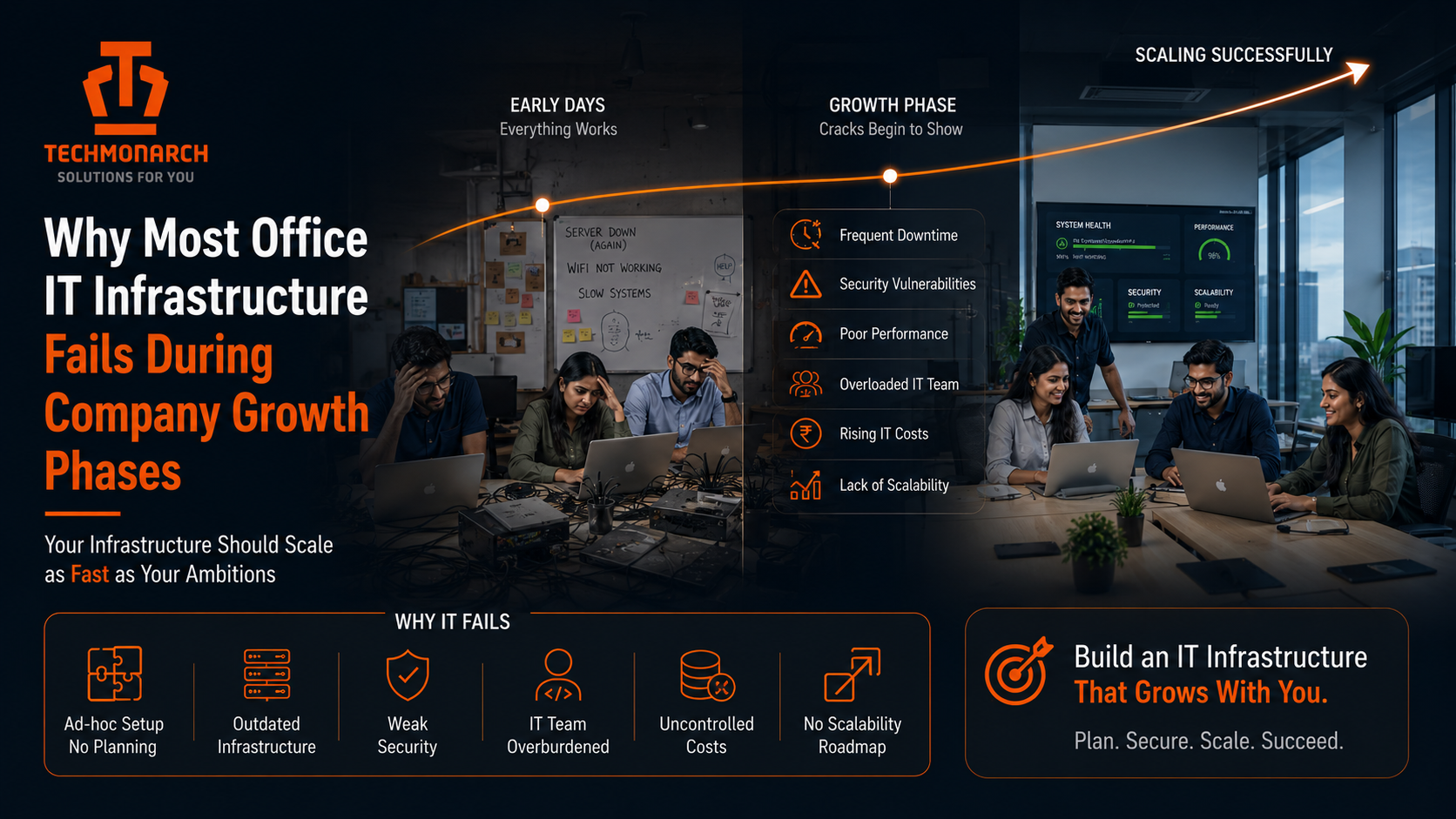
There is a pattern that repeats itself in growing companies so consistently it has become almost predictable. A business that was lean and agile at 20 people starts hitting operational friction at 60. By the time it reaches 150, the IT environment — which worked perfectly well just a few years ago — has become a source of daily problems: systems that cannot talk to each other, helpdesk queues that never empty, security policies that exist on paper but not in practice, and a network that was never designed to handle the traffic it is now being asked to carry.
None of this is accidental, and it is not the result of poor decisions at any single point. It is the natural outcome of infrastructure that was built for one version of the company being asked to serve a fundamentally different one. Growth changes almost everything about how an organization needs its technology to behave — and most IT infrastructure, built incrementally and reactively, simply was not designed with that trajectory in mind.
This article is for IT managers and business owners who either recognize this pattern already or want to understand it well enough to get ahead of it.
The Architecture Designed for Yesterday
Most small and mid-sized companies build their IT infrastructure the same way. It starts with a handful of laptops, a router, maybe a basic server or a cloud storage account. Each addition makes sense at the time. The team grows, so you add more machines. A department needs shared files, so you configure a shared drive. Security becomes a concern, so you add antivirus. A new application is required, so you provision it alongside everything else that is already running.
The result, five or six years down the line, is a layered architecture that no single person fully understands. Systems that were added for separate reasons now have undocumented interdependencies. Network segments exist because someone configured them once and nobody changed them. Access permissions were granted informally and never revoked. Backup configurations were set up when the data volume was a fraction of what it is today.
This is not a failure of IT management — it is a failure of infrastructure planning, which is a different thing. Infrastructure planning requires projecting forward: understanding not just what the business needs today, but what it will need when it is twice as large and operating with twice as many moving parts. That kind of forward-looking architecture work tends not to happen in organizations that are focused on near-term execution, which describes most fast-growing companies.
The consequence is an IT environment that was designed, implicitly or explicitly, for yesterday’s company — and is now being asked to serve tomorrow’s.
The Six Places Infrastructure Breaks First
Growth stress does not land evenly across an IT environment. Certain failure points appear earlier and more predictably than others. Understanding which layers crack first helps prioritize where attention is needed.
Network capacity and topology tend to be the earliest visible failure. A network configured for 30 concurrent users behaves very differently with 100. Bandwidth saturation, latency on internal applications, and Wi-Fi dead zones all emerge around the same growth inflection point. These failures are visible and disruptive, which means they do get addressed — but usually in a reactive, patch-by-patch way that introduces new complexity rather than resolving the underlying capacity problem.
Identity and access management breaks in a less visible but more consequential way. In a small company, access permissions are informal: someone needs access to a folder or a system, the IT contact grants it, and no one keeps a systematic record. As the organization grows, former employees retain access to systems they no longer need, new employees get permissions that are inconsistent with their roles, and the administrative overhead of managing it all informally becomes unsustainable. The risk here is not just operational — it is a significant security exposure.
Helpdesk and support capacity breaks when the IT team — often a single person or a small team — is sized for a smaller organization. At 20 employees, one IT person can manage the environment and handle issues as they arise. At 80, the same person is fielding a constant stream of support requests while also being responsible for infrastructure maintenance, security monitoring, vendor management, and any project work the business needs. The math does not work, and the result is either a perpetual backlog, deferred maintenance, or both.
Collaboration infrastructure breaks when the tools designed for small-team coordination — shared email inboxes, informal chat groups, manual document versioning — are applied at a scale they were not built for. At this point, organizations often accumulate multiple overlapping tools that partially solve the same problem, none of them integrated, all of them generating data in different places.
Backup and disaster recovery configurations break silently. The backup system that was set up for 500GB of data three years ago is technically still running, but may be nowhere near adequate for the 5TB the organization now holds. Recovery time objectives that were acceptable when downtime meant a few people sitting idle are now catastrophic when they mean an entire organization cannot function. These failures do not announce themselves until something goes wrong.
Security posture breaks most dangerously of all. A growing organization has a larger attack surface, more endpoints, more users, and more vendor relationships — all of which introduce new vulnerabilities. A security approach that was appropriate for a small, centralized team is rarely adequate for a distributed, multi-site, multi-device organization. And unlike network outages or helpdesk backlogs, security failures may not be noticed until significant damage has been done.
The Technical Debt That Growth Exposes
McKinsey research on technical debt found that it accounts for approximately 40 percent of IT balance sheets on average — a number that most business leaders would find surprising if they were asked to put it on a spreadsheet next to their capital assets. The same research noted that the costs of unaddressed technical debt compound over time, making every future IT initiative more expensive than it would otherwise need to be.
For growing companies, technical debt has a specific and important characteristic: it is largely invisible until a growth event forces it into the open. A legacy application that runs fine at current load will surface its architectural limitations the moment load increases significantly. An undocumented system configuration that nobody has needed to change for three years becomes a critical problem the first time a major software upgrade requires it to be modified. A network design that handles current traffic adequately becomes the bottleneck the moment a new office or a significant hiring wave adds volume it was never sized for.
This is why infrastructure failures during growth phases so often appear to come from nowhere. They were not sudden failures — they were accumulated deficiencies that the organization’s growth finally forced above the surface. The company did not break its infrastructure by growing. It grew into the consequences of decisions that had been deferred for years.
The organizations that manage this best tend to have one thing in common: they treat infrastructure assessment as a regular activity rather than a one-time event. They review their IT environment against current and projected needs on a structured cadence, identify the gap between where the infrastructure is and where the business is heading, and address the most critical gaps before they become crises.
Why Reactive IT Compounds the Problem
There is a mode of IT management that is extremely common in growing companies and extremely costly: pure reaction. Fix what breaks. Address what is requested. Replace what fails. Do nothing until something forces your hand.
This is understandable. IT teams in growing organizations are usually running at full capacity just managing the present. There is rarely discretionary time for the kind of forward-looking planning that would prevent future problems. And business leadership often does not prioritize IT investment until something breaks — which means the IT team spends its energy on emergencies rather than prevention.
The problem is that reactive IT management makes the underlying infrastructure problem progressively worse. Every patch that addresses a symptom without resolving the root cause adds to the complexity of the environment. Every emergency fix that is not properly documented becomes a new piece of undocumented configuration. Every workaround that is allowed to persist becomes a dependency that complicates future work. The Ponemon Institute has documented that unplanned IT downtime costs organizations an average of $9,000 per minute at enterprise scale — and while SMB numbers are smaller in absolute terms, the proportional impact on revenue and operations is often more severe.
The organizations in Ahmedabad and Gandhinagar that Techmonarch works with frequently arrive at a managed services or infrastructure planning engagement at exactly this inflection point — after a growth phase has exposed the limits of a reactive approach, and before those limits translate into something more serious. The conversation is almost always the same: the infrastructure was adequate, then growth happened, and now it is not. The question is whether to keep patching or to plan.
What Proactive Infrastructure Planning Actually Requires
Proactive infrastructure planning is not complicated in concept, but it does require a few things that most growing companies struggle to find at the same time: visibility into the current state of the environment, a credible model of where the business is heading over the next 12 to 36 months, and the technical expertise to map the gap between those two things into a prioritized set of investments.
Visibility is often the hardest part. Most organizations do not have accurate, current documentation of their IT environment. They know roughly what they have, but the details — software versions, license states, network configurations, data locations, backup schedules, access rights — are either undocumented or documented incorrectly. An infrastructure assessment that surfaces this information is the necessary starting point for any planning work, and it consistently reveals more than the organization expected.
The projection model does not need to be precise. It needs to be honest. How many people will the organization employ in 24 months? Are there plans for new locations or remote teams? Are there regulatory or compliance changes on the horizon? Are there applications or systems that will need to be replaced within that window? The answers to these questions define the growth envelope that the infrastructure needs to be designed to serve.
The gap between current state and projected requirements, mapped against a timeline and a budget, is the infrastructure roadmap. It is not a document that gets created once and filed away — it is a working tool that gets updated as the business changes. The organizations that use it most effectively treat it as a living plan: revisited quarterly, adjusted as priorities shift, and explicitly connected to the business strategy rather than existing in a separate IT silo.
Headcount Is Not the Only Growth Trigger
One important nuance worth flagging: infrastructure stress during growth phases is not always driven by headcount. Companies that are growing rapidly in data volume, in geographic footprint, in regulatory complexity, or in the number of integrated systems they manage can encounter exactly the same failure patterns without adding a single employee.
A manufacturing business in Gujarat that adds a second plant faces an infrastructure challenge that is as significant as doubling its office headcount. A professional services firm that wins a large client with specific data security requirements may need to overhaul its security architecture before it can onboard that client. A retail business that expands into e-commerce suddenly has transaction data, customer data, and inventory systems that need to integrate reliably under load — requirements that the existing infrastructure was never designed to meet.
In each of these cases, the growth trigger is different, but the underlying dynamic is the same: the business has moved faster than the infrastructure, and the gap is now a operational risk. Recognizing that growth comes in multiple forms — not just people, but data, geography, complexity, and obligation — is important for IT leaders who are trying to plan ahead rather than respond to crises.

The Right Time to Reassess
If there is a single practical takeaway from everything above, it is this: the right time to assess your infrastructure against your growth trajectory is before the failures start, not after. This sounds obvious, but the timing is genuinely difficult because the pressure to reassess only becomes acute once problems have already emerged.
A useful heuristic: any time the business is about to cross a meaningful threshold — 25 employees, 50, 100; a new office or location; a significant new client or market; a compliance certification process — that threshold is a trigger to revisit the infrastructure plan. These events change the requirements enough that the existing environment should be explicitly validated against the new context, rather than assumed to be adequate.
The organizations that handle growth phases well are not necessarily the ones with the most sophisticated infrastructure. They are the ones that know what they have, have thought honestly about where they are going, and have made deliberate decisions about what to invest in and when. That combination of visibility, foresight, and deliberate planning is what separates the companies that scale their IT alongside their business from the ones that spend their growth phase firefighting infrastructure problems they could have seen coming.
Recent Posts
- Why IT Vendors in Ahmedabad Take Days to Respond — And What "Managed" Should Actually Mean
- Why More Ahmedabad Companies Are Switching From Freelance IT Support to Managed Partners
- What Ahmedabad Businesses Get Wrong About IT Compliance Under India's DPDP Act
- A Look Inside How We Manage IT Infrastructure for Ahmedabad Businesses Across Industries
- Why Gandhinagar's Growing IT/ITES Sector Needs Local Managed Support, Not Remote-Only Vendors
Recent Comments
- No comments to show