
-
Vijit
- June 8, 2026
- No categories assigned.
- No Comments
There’s a conversation that happens in almost every mid-sized company at some point. The IT head walks into a leadership meeting and gets asked, “Why isn’t your team working on the digital transformation initiative?” And the answer, delivered with barely concealed exhaustion, is always some version of: “Because we’re busy keeping the lights on.”
Patch cycles. Helpdesk tickets. Server monitoring. Backup verification. License renewals. These tasks are not glamorous, but they are absolutely non-negotiable. Skip them and things break, sometimes badly. But spend all your time on them and your internal IT talent, the people you hired to think strategically, ends up buried under a mountain of operational chores.
This is precisely the problem that co-managed IT is designed to solve. And if you already have an internal IT team and you’ve been vaguely aware that the model exists, what follows isn’t an introduction to the concept. It’s a deeper look at how the division of labour actually works in practice, what tends to go wrong when it isn’t set up carefully, and how organizations get the most out of it.
The Tyranny of Routine Work
Most IT professionals didn’t enter the field to spend their days resetting passwords and rebooting printers. They got in because infrastructure fascinates them, because they like solving hard problems, or because they wanted to be at the centre of how technology shapes how businesses function. But somewhere between their job description and their calendar, a significant gap emerges.
Routine maintenance is one of those things that expands to fill all available time. The backlog never quite clears. A patch gets applied and another is already waiting. A monitoring alert resolves and two more surface. This isn’t a reflection of the team’s competence. It’s the structural reality of running IT at any meaningful scale.
What gets sacrificed is forward-looking work. Cloud architecture evaluations sit half-finished. Automation scripts that would save hours each week never get written. Security posture reviews happen once a year instead of continuously. The cost of this isn’t always visible on a balance sheet, but it shows up as delayed projects, slower response to business needs, and a growing technical debt that eventually becomes very expensive to unwind.
What Co-Managed IT Actually Means in Practice
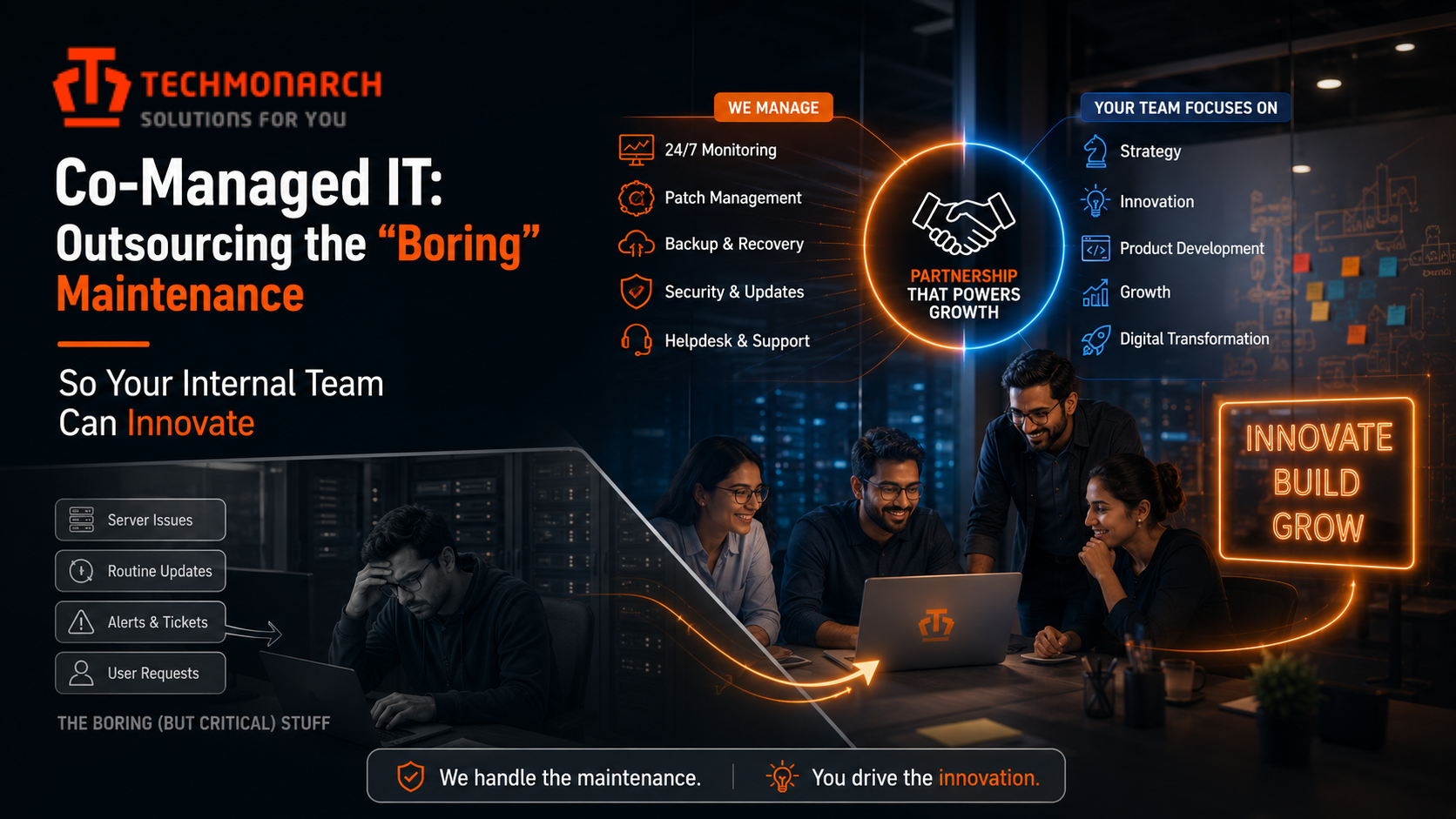
The term co-managed IT gets used loosely, so it’s worth being precise. It refers to a model where an external managed service provider takes on a defined portion of your IT operations while your internal team continues to own the rest. The key word is “defined”. This is not a vague arrangement where responsibilities blur. It’s a deliberate carving up of the workload based on where each party adds more value.
In most co-managed arrangements, the external provider absorbs the operationally intensive, time-consuming tasks that require consistent execution but not deep institutional knowledge of your business. Think 24/7 monitoring, patch management, endpoint protection, helpdesk triage, and backup verification. Your internal team, meanwhile, retains ownership of architecture decisions, vendor relationships, business-specific integrations, and anything that requires them to understand context that only exists inside your organization.
This distinction matters a great deal. The institutional knowledge your team carries, how your ERP is configured, what the finance team actually needs from the system, why a particular firewall rule exists, is genuinely difficult to replicate externally. A co-managed model preserves that knowledge inside the company while outsourcing the operational weight that doesn’t depend on it.
Where the Dividing Line Should (and Shouldn’t) Be
One of the more common mistakes in co-managed engagements is drawing the line in the wrong place. Organizations sometimes outsource functions that are genuinely strategic and retain functions that are genuinely operational, and the arrangement ends up working backwards.
A useful way to think about it: ask whether a function requires deep knowledge of your specific business context, or whether it can be executed well by someone following a well-defined process. Tasks that fall into the second category are candidates for outsourcing. Tasks that fall into the first should stay internal.
Functions that typically transfer well to a co-managed provider:
- Round-the-clock infrastructure monitoring and alert management
- Patch management across servers, endpoints, and third-party software
- Helpdesk support for standard end-user issues
- Backup execution and restoration testing
- Vulnerability scanning and routine security reporting
- Compliance documentation and audit trail maintenance
Functions that should generally stay internal:
- IT strategy and technology roadmap development
- Vendor selection and contract negotiation
- Architecture decisions tied to business applications
- Data governance and classification policies
- Internal stakeholder relationships and change management
Cybersecurity sits somewhere in the middle and deserves special mention. Threat monitoring and incident triage can be handled externally with the right tooling and SLAs. But the decisions about what to protect, what risk tolerance is acceptable, and how security posture maps to business priorities have to involve people who understand the business. A split model works well here: execution externally, governance internally.
The Overhead Nobody Talks About
There’s an honest conversation to have about what co-managed IT actually costs your internal team in terms of coordination. It is not zero. Any time you split operational responsibility between two parties, you introduce interface points: handoff procedures, escalation paths, shared tooling, documentation standards, and regular syncs to make sure nothing falls between the cracks.
Organizations that get this right tend to invest real time at the beginning in defining ownership clearly. They document what each party is responsible for, how escalations work, what the SLA expectations are, and how the toolsets will be integrated. This upfront investment pays dividends. Organizations that skip this step often find themselves dealing with duplicate effort, gaps in coverage, or friction every time an edge case arises.
The other thing worth noting is that co-managed IT works best when the external provider has genuine visibility into your environment. That means shared tooling wherever possible, read-access to relevant systems, and honest communication about where your infrastructure is healthy and where it’s fragile. Providers who are kept at arm’s length tend to be less effective because they’re always working with incomplete information.
What This Unlocks for Your Internal Team
When done well, the operational breathing room that co-managed IT creates is significant. Internal IT professionals who were spending sixty to seventy percent of their time on reactive, maintenance-driven work suddenly have space to think. Projects that have been on the backlog for eighteen months start moving. Proof-of-concepts get run. Automation initiatives that were always “something we’ll get to eventually” actually get built.
For IT leadership, the shift is particularly meaningful. Instead of spending most of their time triaging operational issues, they can engage more meaningfully with the business: understanding where technology can create competitive advantage, participating in product and strategy discussions, and building a roadmap that the business actually believes in.
There’s also a talent dimension. Skilled IT professionals are increasingly selective about where they work. A role that’s primarily reactive and maintenance-focused is harder to fill and harder to retain talent in than one that has genuine scope for strategic and technical depth. Co-managed IT, by clearing away the lower-value work, makes internal IT roles more interesting and more sustainable.
Thinking About the Right Scope for Your Organisation
The honest answer to “what should we co-manage?” is: it depends on where your team’s time is actually going versus where it should be going. The starting point for any serious co-managed engagement is an audit of how internal IT capacity is being spent. Most teams, when they do this exercise honestly, find a significant proportion of their time going to activities that are repeatable, process-driven, and not dependent on any knowledge that only exists inside the organisation.
From there, the question becomes which of those activities benefit from external scale, tooling, or round-the-clock coverage that would be expensive to provide internally. Night-time monitoring is an obvious example. Most internal IT teams are not staffed for 24/7 coverage, but the systems they manage don’t switch off at 6pm. Outsourcing that monitoring to an MSP that already has the staffing and tooling in place is typically far more cost-effective than building it yourself.
For organisations in Gujarat navigating this decision, regional factors matter. Familiarity with the local vendor landscape, awareness of compliance requirements specific to Indian businesses, and the ability to provide onsite support when remote resolution isn’t sufficient all influence what a good co-managed arrangement looks like. Providers like Techmonarch (techmonarch.com/in) operate with exactly this combination in mind, supporting internal IT teams across Ahmedabad and Gandhinagar with managed services and staff augmentation that fit around existing team structures rather than displacing them.
Making the Transition Without Disruption
One concern that comes up reliably in co-managed conversations is the risk of disruption during the transition. The worry is understandable: you’re introducing an external party into an environment that your team knows intimately, and there’s always a risk of things breaking in the handover.
The organisations that navigate this best tend to phase the transition rather than attempting a large handover all at once. Start with the functions that are most clearly operational and least risky: monitoring, for example, or helpdesk triage for a defined set of issue types. Get the tooling integrated, establish the communication patterns, and build confidence that the handoff works before expanding scope.
Documentation is the other thing that separates smooth transitions from painful ones. If your internal team is carrying tribal knowledge about how systems work, a transition is actually a good forcing function to get that knowledge written down. Not just for the co-managed provider’s benefit, but for the organisation’s resilience generally. Systems that only work because one person knows how they work are a risk regardless of whether you’re bringing in external support.
The Real Goal: Time for What Matters
Co-managed IT is not a cost-cutting measure, at least not primarily. Done well, it can reduce operational costs, but that’s a secondary outcome. The primary value is about how your internal IT team spends its time and attention. An internal team that’s stuck in reactive mode cannot think clearly about the future. They’re too busy.
The organisations that use co-managed IT most effectively treat it as an intentional reshaping of where their internal talent is deployed. Maintenance, monitoring, and routine support go to the provider. Architecture, strategy, and innovation stay inside. The result is an IT function that actually has the capacity to do what leadership always says it should be doing, but rarely has the bandwidth to pursue.
For IT leaders and business owners who have been living with the tension between operational demands and strategic ambitions, the co-managed model offers something genuinely useful: not a magic solution, but a more honest and sustainable division of labour. One where your best people are working on the hardest problems, not the most repetitive ones.
Recent Posts
- Why IT Vendors in Ahmedabad Take Days to Respond — And What "Managed" Should Actually Mean
- Why More Ahmedabad Companies Are Switching From Freelance IT Support to Managed Partners
- What Ahmedabad Businesses Get Wrong About IT Compliance Under India's DPDP Act
- A Look Inside How We Manage IT Infrastructure for Ahmedabad Businesses Across Industries
- Why Gandhinagar's Growing IT/ITES Sector Needs Local Managed Support, Not Remote-Only Vendors
Recent Comments
- No comments to show