
-
Vijit
- May 14, 2026
- No categories assigned.
- No Comments
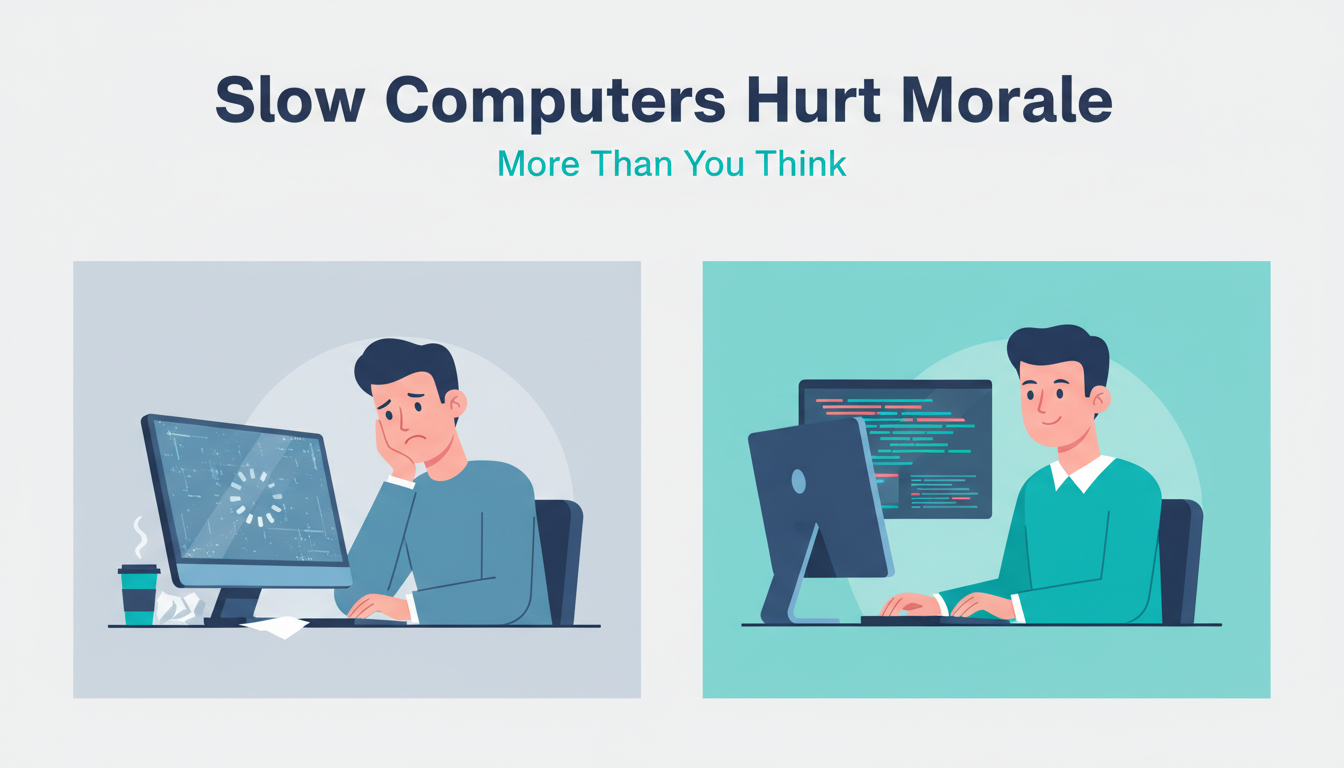
Let’s be honest — there’s a specific kind of frustration that comes with a slow computer. You click something, nothing happens. You wait. You click again. The spinning wheel of doom appears. Sound familiar? If you’re nodding your head right now, you already know this feeling personally. But here’s what most business owners don’t realize: this isn’t just an inconvenience. It’s actually hurting your people in ways that science can explain — and it’s costing your business more than the price of a new laptop.
At TechMonarch, we work with companies across Ahmedabad every day, setting up and managing IT infrastructure and providing managed IT services. And one of the most underestimated conversations we have with business owners is this one: the link between slow technology and employee well-being. So let’s dig into it — properly.
It’s Not Just Annoyance — It’s a Psychological Load
There’s a concept in cognitive psychology called “cognitive load,” which is the mental effort needed to process information and finish tasks. When your computer is slow, you’re not just waiting; your brain is actively holding on to incomplete tasks. This is known as the Zeigarnik Effect, a well-known psychological phenomenon where people remember uncompleted or interrupted tasks much better than completed ones. Basically, your brain keeps “open tabs” for every interrupted workflow, and that mental clutter adds up.
A study in the journal Computers in Human Behavior found that “technostress,” or stress caused by technology, is a real and measurable source of anxiety in modern workplaces. When workers have to deal with slow systems just to do their jobs, they get more frustrated, lose focus, and feel more helpless. None of these things make for a productive or happy workday.
It’s a bit like trying to run a race with your shoelaces tied together. You’re capable, you’re motivated — but the environment is working against you.
The Morale Connection Is Deeper Than You Think
This is where things get really interesting. Morale isn’t just about having a nice boss or free snacks in the break room. It’s deeply tied to a person’s sense of autonomy, competence, and progress at work. Psychologist Teresa Amabile from Harvard Business School has spent decades researching workplace motivation, and her findings are clear: nothing drives morale more than the feeling of making progress on meaningful work.
Now imagine your team member — let’s call her Priya. She’s a sharp accounts executive. She knows what she needs to do, she’s motivated, and she’s ready to tackle her morning. But her computer takes four minutes to boot up. Her accounting software freezes mid-entry. Uploading a report to the server takes an eternity. By 10 AM, Priya hasn’t felt a single moment of productive flow. She hasn’t made progress. And somewhere in her mind, even if she can’t articulate it, she starts feeling like she’s failing — when in reality, she’s just been failed by her tools.
Do this to Priya five days a week, fifty weeks a year, and you’ve got a demoralised employee who’s quietly updating her resume.
The Numbers Don’t Lie
Let’s talk about what this looks like on a practical level, because numbers have a way of making things real.
A 2023 survey by Aternity (now Riverbed) found that 49% of employees said slow or malfunctioning technology made them consider leaving their job. Nearly half. And a separate report by Oxford Economics highlighted that technology dissatisfaction was among the top reasons employees cited for disengagement — ranking higher than concerns about compensation in several industry segments.
Closer to what we see in Ahmedabad’s growing corporate landscape, small and mid-sized businesses often delay IT upgrades to save costs. And that’s understandable — budgets are real. But what often goes uncalculated is the hidden cost: productivity hours lost per employee, the support time IT teams spend troubleshooting aging machines, and the very real risk of losing good talent to competitors who’ve invested in better tools.
One commonly cited figure from research by Gallup indicates that disengaged employees cost businesses between 34% of their annual salary in lost productivity. If a slow computer contributes to even a fraction of that disengagement — and research suggests it does — the ROI on upgrading your IT infrastructure pays for itself quickly.
It’s Also About Respect — And Employees Know It
There’s an emotional layer to this that often goes unspoken. When employees are given outdated, malfunctioning equipment, many of them read it as a signal: “This company doesn’t value my time.” It might not be the message the business owner intends to send, but it’s frequently the message received.
This perception matters enormously. Research from Gallup’s State of the Global Workplace reports consistently shows that feeling supported by one’s employer is one of the strongest predictors of employee engagement. Technology is a tangible, daily expression of that support — or the lack of it.
We’ve had clients come to us at TechMonarch specifically because their employees started complaining about equipment. In several cases, the conversation revealed something surprising: the employees weren’t even asking for the latest and greatest tech. They just wanted things that worked all the time, without any drama. That’s a pretty fair request.
The Ripple Effects on Team Culture
Slow technology doesn’t just affect one person at a time; it also affects how teams work together in small but real ways. For example, when one person’s computer is slow, meetings get pushed back and files take longer to open. Collaborative tools like Teams or Zoom stutter and freeze. Group momentum dies.
And here’s the thing about momentum in a team environment: it’s hard to rebuild once it’s gone. People start working around each other’s bottlenecks. Workarounds become habits. And habits — especially inefficient ones — are notoriously difficult to break.
There’s also the fatigue factor. Context switching — jumping between tasks because your system is lagging — is one of the most mentally exhausting things you can ask a human brain to do. Research from the American Psychological Association shows that multitasking (or being forced into it by slow systems) can reduce productivity by as much as 40%. That’s not a small number. That’s nearly half a person’s effective output — gone.
What the Right IT Setup Actually Does for People
Alright, let’s flip the perspective. Because it’s not all doom and gloom — in fact, this is where things get exciting.
When businesses invest in properly managed IT infrastructure — fast machines, reliable networks, well-configured software environments — something quietly transformational happens. People stop thinking about their tools and start thinking about their work. That’s the goal. That’s what great IT infrastructure enables.
This is essentially what we aim for at TechMonarch with every infrastructure project we take on. Whether it’s setting up a company’s server environment from scratch, migrating to cloud-based systems, or simply ensuring that endpoint devices are properly maintained and optimised — the objective is always the same: remove friction from people’s workdays so they can actually do what you hired them to do.
Companies that invest in good IT infrastructure also report lower IT support costs over time. Because proactive management — catching issues before they become problems — is always cheaper than reactive firefighting. It’s the same reason you service your car rather than waiting for it to break down on the highway.
A Word to Business Owners in Ahmedabad
If you’re running a business in Ahmedabad — whether it’s a growing startup in SG Highway, a manufacturing firm in Naroda, or a financial services company in Prahlad Nagar — your people deserve tools that support their best work. The city’s business landscape is evolving fast, and so is the talent pool. Retaining good employees requires more than competitive salaries. It requires a workplace where people feel equipped, respected, and able to do meaningful work without unnecessary friction.
The science is clear. The morale impact of slow computers is real. And the good news is — it’s fixable. It doesn’t always require massive capital investment. Sometimes it’s about better maintenance, smarter configuration, or a phased upgrade plan that spreads costs across time.
At TechMonarch, we work with businesses of all sizes to assess their current IT environment, identify bottlenecks, and build practical plans that actually work within real-world budgets. Because we genuinely believe that good IT is the foundation of a productive, happy, and growing business.

Final Thought
Slow computers are not a minor inconvenience. They are a documented source of psychological stress, a measurable drain on productivity, a quiet killer of morale, and — perhaps most importantly — a signal to your employees about how much you value their time and work.
The next time someone on your team complains about their machine being slow, don’t just add it to the to-do list. Think about what that frustration is actually costing — in productivity, in morale, in talent retention — and ask whether the fix might be simpler than you think.
Because it usually is.
— TechMonarch | Helping businesses build better IT, one system at a time.
Recent Posts
- What Ahmedabad Businesses Get Wrong About IT Compliance Under India's DPDP Act
- A Look Inside How We Manage IT Infrastructure for Ahmedabad Businesses Across Industries
- Why Gandhinagar's Growing IT/ITES Sector Needs Local Managed Support, Not Remote-Only Vendors
- IT Infrastructure Checklist for Companies Moving Into SG Highway and Prahlad Nagar Offices
- How Ahmedabad-Based Startups Can Build Enterprise-Grade IT Without Enterprise Budgets
Recent Comments
- No comments to show