
-
Vijit
- April 2, 2026
- AI
- No Comments
| 39% faster resolution times with AI helpdesk automation (ZenAdmin) | 80% of routine inquiries handled without human intervention (Fullview) | $3.50 returned for every $1 invested in AI customer service (McKinsey) | 50%+ reduction in MTTR reported by early AI helpdesk adopters (Moveworks) |
There’s a lot of noise about AI right now. Depending on who you ask, it’s either going to solve every problem known to humanity or put half the workforce out of a job by next Tuesday. The truth, as usual, is somewhere far more practical — especially when it comes to IT support.
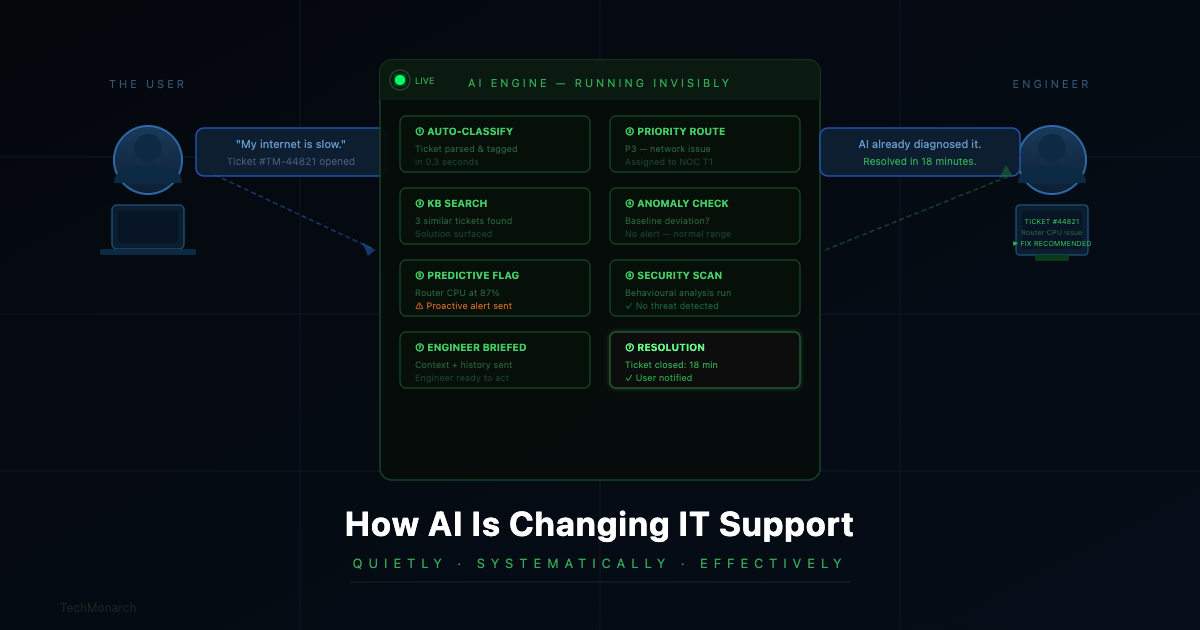
AI isn’t replacing IT engineers, and it isn’t making human expertise obsolete. What it is doing — quietly, systematically, and rather effectively — is changing how support works behind the scenes. Faster triage. Smarter monitoring. More consistent outcomes. And for businesses relying on managed IT services, that translates directly into less downtime, fewer surprises, and a noticeably better day-to-day experience.
Let’s get into the specifics of what that actually looks like.
First, Let’s Be Clear About What ‘AI in IT Support’ Actually Means
When most people hear ‘AI in IT,’ they picture a chatbot that gives you the same useless answer three times before eventually transferring you to a human. That’s one version of it — and frankly, not the most impressive one.
The more meaningful applications are happening in the background, mostly invisible to end users:
- Monitoring systems that learn what ‘normal’ looks like for your network and alert engineers the moment something deviates from that baseline
- Ticketing platforms that automatically classify, prioritise, and route issues without human intervention — using natural language processing to understand the request, not just keyword-match it
- Predictive tools that analyse hardware health data and flag devices likely to fail before they actually do
- Security tools that use behavioural analysis to detect threats that signature-based antivirus would completely miss
- Knowledge base systems that surface relevant past solutions the moment a similar ticket is opened
None of these replace the engineer. All of them make the engineer significantly more effective.
Seven Ways AI Is Changing IT Support Right Now
1. Predictive Maintenance — Fixing Problems Before They Happen
Traditional IT support is reactive: something breaks, someone notices, someone fixes it. AI changes this equation fundamentally. AI-powered monitoring tools continuously analyse data from servers, workstations, storage systems, and network devices — identifying patterns that tend to precede failures, like deteriorating read/write performance on a drive, a server running unusually hot, or a switch delivering intermittent packet loss. These signals can be visible weeks before the failure occurs. Your IT team schedules a replacement or maintenance window then — not at 9am on a Monday when everything grinds to a halt.
2. Intelligent Ticket Triage and Routing
In an active helpdesk, reading, categorising, prioritising, and assigning incoming tickets — repeated across dozens of requests every day — is time-consuming and prone to inconsistency. AI-powered ticketing systems handle this automatically. Natural language processing reads the ticket, determines category and severity, matches it to the right skill set, and assigns it in seconds. According to G2’s research, AI cuts first response times by 37% and resolves tickets 52% faster on average. The engineer gets a pre-classified ticket with relevant knowledge base articles already surfaced.The resolution process begins more quickly.
3. AI-Assisted Diagnosis
When an engineer tackles a tricky ticket, the initial step often involves hunting down comparable problems that have already been fixed. In a sizable operation, that repository of information can be vast, encompassing thousands of entries. AI goes beyond simple keyword matching; it grasps context and intent, quickly presenting the most pertinent past solutions. More advanced systems take it a step further, cross-referencing reported symptoms with system logs, error codes, and network telemetry to suggest a probable root cause before the engineer even starts their own investigation. It’s not a substitute for human expertise. An amplifier of it.
4. Anomaly Detection in Security
AI is arguably having its greatest impact in cybersecurity. Traditional tools operate on signatures — they identify known threats. AI-based tools operate on behaviour — they establish what normal user and system activity looks like and flag deviations. An employee downloading gigabytes of data at 2am. A user account accessing systems it has never touched before. An in-memory process behaving like ransomware. These are the signals signature-based tools miss, and that behavioural AI picks up in real time, often before damage is done.
5. Self-Service That’s Actually Useful
Not every IT issue requires an engineer. Password resets, software access requests, basic connectivity checks, printer configuration — these are routine tasks that eat up a disproportionate amount of helpdesk time. AI-driven self-service portals and virtual assistants now handle many of them confidently and correctly, walking users through to resolution step by step. If they can’t resolve something, they pass it to a human with full context already summarised. Research from Fullview indicates that AI now handles up to 80% of routine inquiries without human intervention — freeing engineers for work that genuinely requires their expertise.
6. Capacity Planning and Infrastructure Optimisation
AI is excellent at analysing large volumes of performance data longitudinally and identifying patterns that would be invisible in manual review. For IT infrastructure, this means visibility into under-utilised servers burning budget, workloads that would run better in the cloud, storage systems approaching capacity ahead of schedule, and network segments nearing bandwidth limits. Instead of discovering your storage is full when someone tries to save a file, your IT team receives a forecast six weeks out and plans accordingly.
7. Automated Reporting and Service Insights
IT managers and business owners want visibility into their IT operations — not just ‘is it working?’ but ‘how well is it working and where are the trends?’ AI-powered reporting tools pull ticket data, resolution times, recurring issue patterns, SLA adherence, and system performance metrics, then produce clean, readable reports without anyone having to manually extract and format the underlying data. That transforms raw operational data into genuine business intelligence — and gives your IT partner something meaningful to discuss at your next review.
Traditional vs. AI-Augmented IT Support: A Side-by-Side View
| Area | Traditional IT Support | AI-Augmented IT Support |
| Issue Detection | Reactive — discovered when something breaks or a user complains | Proactive — anomalies flagged before they cause visible impact |
| Ticket Triage | Manual — engineer reads, categorises, and assigns each ticket | Automated — AI classifies and routes tickets in seconds using NLP |
| Root Cause Analysis | Trial and error, drawing on individual engineer memory | AI surfaces relevant past cases and system telemetry instantly |
| Security Monitoring | Signature-based — only known threats are caught | Behaviour-based — novel threats detected by deviation from normal |
| Hardware Failures | Discovered after failure — unplanned downtime | Predicted weeks in advance — planned replacement, zero downtime |
| Reporting | Manual data collection — time-consuming and often delayed | Automated real-time dashboards and trend analysis |
| Routine Tasks | Engineer handles all requests regardless of complexity | AI resolves up to 80% of L1 requests; engineers focus on complex work |
Table 1: Traditional vs. AI-augmented IT support across seven key operational areas
A Word on the Human Element — Because It Still Matters
Let’s be direct about something: AI in IT support is a force multiplier, not a replacement. The judgment calls that matter most — understanding a business’s context, recognising when a ‘routine’ issue is a symptom of something bigger, managing vendor relationships, architecting infrastructure that reflects real-world growth trajectories, handling a genuinely novel security incident — these require human expertise, experience, and communication skills that no AI system replaces right now.
What AI does is liberate that human expertise from being consumed by the sheer volume of routine, repetitive work that fills a busy helpdesk. When an engineer’s day isn’t dominated by password resets and printer triage, they have the capacity for deeper, higher-value work that actually moves the needle for your business. The most effective IT teams today are the ones that have purposefully integrated AI tools into their workflows — not replaced their engineers with them.
What This Means for SMBs — Practically Speaking
For small and mid-sized businesses, the rise of AI in IT support has a genuinely exciting implication: access to enterprise-grade capabilities without enterprise-grade costs. Five years ago, predictive monitoring, behavioural threat detection, and intelligent ticket routing were the exclusive domain of large organisations with large IT budgets. Today, they’re embedded in the managed IT platforms that providers like TechMonarch use to support businesses of all sizes.
When you engage a managed IT provider that has thoughtfully integrated AI into their operations, you’re getting:
| What AI-Backed Managed IT Delivers for Your Business Faster issue resolution — because triage is instant and diagnosis is AI-assisted from the first moment Fewer surprises — because predictive monitoring catches problems before they become visible disruptions Better security — because behavioural analysis catches what signature tools miss More proactive service — because your provider is anticipating, not just reacting Cleaner reporting — because you can see exactly how your IT is performing at any time, without waiting for someone to pull the data |
That’s a genuine competitive advantage — and it doesn’t require building an in-house AI team or spending heavily on enterprise software licences.
Questions to Ask Your IT Provider About AI
Not every IT provider has genuinely integrated AI into their operations. Some are using the word as a marketing label on tools that are essentially unchanged. Here’s how to cut through the noise quickly:
- What monitoring tools do you use — and do they use ML-based anomaly detection or just threshold-based alerting?
- How are support tickets classified and routed — manually, rule-based, or through a genuine AI-assisted system?
- Do you use predictive tools for hardware health monitoring, and can you show me an example of a failure you caught in advance?
- What security tools do you use, and do they include behavioural analysis or just signature-based detection?
- Can you show me an example of an automated report your system generates — what does it actually look like?
The answers will quickly reveal whether a provider is genuinely using AI to deliver better outcomes — or just using the word to sound current.
Closing Thought: AI Is a Tool — The Team Behind It Defines the Outcome
AI is reshaping IT support in real, practical ways. Monitoring is smarter, security is sharper, helpdesks are faster. For businesses, this translates to reduced downtime, enhanced security, and a more proactive approach from their IT partners.
The crux of exceptional IT support remains unchanged: the skill, discernment, and dedication of the individuals working for you. At TechMonarch, we utilize every available resource, from AI to more traditional methods, to ensure our clients receive the finest IT experience. It’s not about chasing fads. Because it genuinely helps us serve you better.
Recent Posts
- What Ahmedabad Businesses Get Wrong About IT Compliance Under India's DPDP Act
- A Look Inside How We Manage IT Infrastructure for Ahmedabad Businesses Across Industries
- Why Gandhinagar's Growing IT/ITES Sector Needs Local Managed Support, Not Remote-Only Vendors
- IT Infrastructure Checklist for Companies Moving Into SG Highway and Prahlad Nagar Offices
- How Ahmedabad-Based Startups Can Build Enterprise-Grade IT Without Enterprise Budgets
Recent Comments
- No comments to show