
-
Vijit Doshi
- April 6, 2026
- Cloud
- No Comments
What They Actually Are and How to Pick the Right One
If you’ve sat in a vendor demo recently, you’ve probably heard ‘cloud’ used about forty times while somehow leaving less clear about what it means. Public cloud, private cloud, hybrid cloud, multi-cloud, cloud-native — it stacks up fast.
So here’s the plain version. Three models, what each one actually is, when it makes sense, and when it doesn’t. We’ll skip the sales language.
One quick analogy first, because it makes everything easier to hold onto:
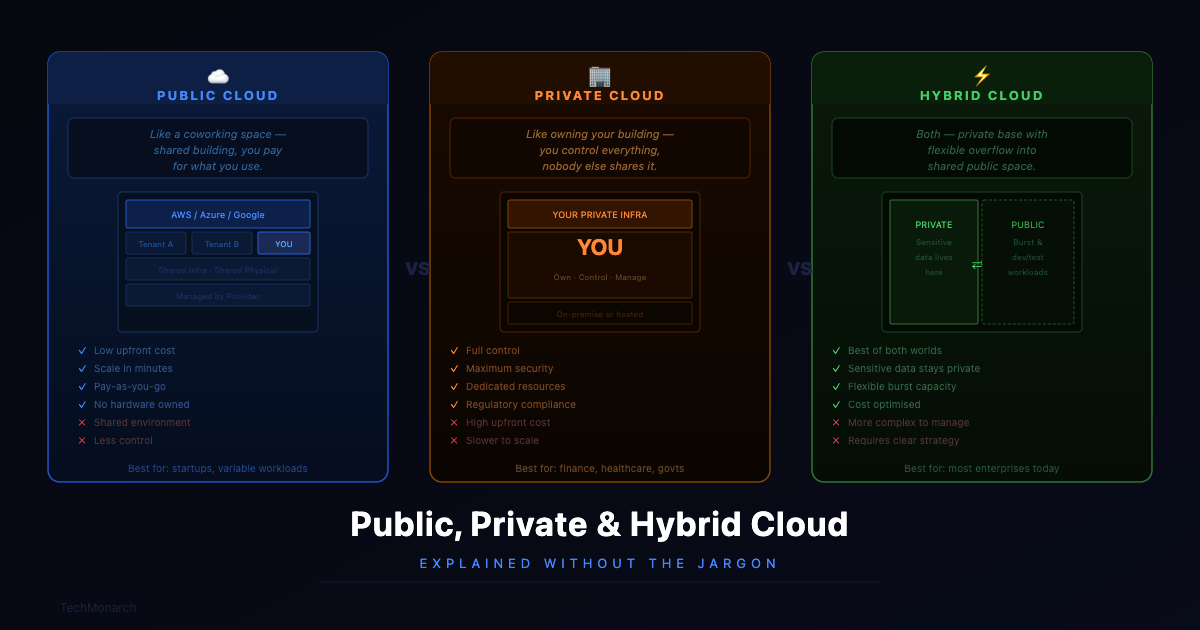
- Public cloud = a coworking space. You rent a desk in a shared building. Everything is managed for you. Other companies are in there too, but your work is your own.
- Private cloud = a building your company owns. You control everything inside. More expensive, nothing shared.
- Hybrid cloud = you own your building for the sensitive work, but you also rent desks at the coworking space when you need flexibility or extra space.
Keep that in mind. It makes the tradeoffs obvious.
Public Cloud
Public cloud means your apps, data, and computing run on infrastructure owned by someone else — AWS, Microsoft Azure, Google Cloud, or in India, providers like Tata Communications or Jio Cloud. You access it over the internet. You never see the servers. You pay for what you use.
If your team uses Gmail, Microsoft 365, Zoho, Salesforce, or Tally on the browser — you’re already on public cloud. Most SMBs are, whether they call it that or not. That’s fine. It’s genuinely the right answer for most growing businesses.
The upsides are real: no upfront hardware cost, scales up in minutes, the provider handles all maintenance and updates, accessible from anywhere. Global public cloud spend is forecast to hit $723 billion in 2025, up 21.5% from last year, and 63% of SMB workloads are now hosted in the cloud. It’s not a niche choice anymore.
But the cost part is worth watching. Cloud bills grow with usage — more storage, more compute, more data transfers, more to pay. 70% of organisations hit unanticipated costs during cloud migration. Not because cloud is expensive, but because it’s easy to not pay attention until the bill lands. It also means you’re dependent on your internet connection — no connectivity, no access. Worth knowing if your office has unreliable broadband.
| Public Cloud — Quick Take Best for: Most SMBs, startups, remote or hybrid teams. Businesses that want someone else managing the infrastructure. Not ideal for: Organisations with strict data residency rules that public providers can’t meet, or applications that absolutely cannot depend on internet connectivity. |
Private Cloud
Private cloud is a bit of a loaded term. The core idea: cloud-style infrastructure — virtualised servers, flexible resource allocation, centralised management — but running on hardware that only your organisation uses. That might be servers in your own server room, or a dedicated environment in a colocation data centre where your gear sits in a locked cage and nobody else touches it.
The defining thing is exclusivity. No shared infrastructure with other companies. You’re not on the same physical kit as a thousand other businesses.
Who actually needs this? Mainly organisations where the regulatory or compliance requirement is specific and non-negotiable. A hospital where patient records must stay on-premise. A financial institution where RBI compliance dictates how data is stored and who accesses it. A manufacturer whose factory floor systems run on private servers because they genuinely cannot tolerate internet dependency. A government department that, by policy, cannot put citizen data on shared infrastructure.
For everyone else, private cloud is usually more than you need. The upfront cost is real — servers, networking, storage, and then the ongoing cost of maintaining and eventually replacing all of it. You own the responsibility for patching, monitoring, and security. And when you need to scale, you buy hardware. That’s a slow, expensive cycle compared to clicking a button in a cloud console.
| Private Cloud — Quick Take Best for: Healthcare, financial services, legal, government, and manufacturing businesses with specific regulatory or performance requirements that public cloud can’t meet. Not ideal for: Most SMBs without strict compliance needs. Owning servers without the IT capability to manage them properly is a liability, not an asset. |
Hybrid Cloud
Hybrid cloud isn’t a product. It’s a strategy — deliberately combining public and private environments, with the two connected and able to work together.
That word ‘deliberately’ matters. Using Microsoft 365 for email and also having an old server in the corner doesn’t make you a hybrid cloud company. A real hybrid setup is intentional: specific workloads placed in the environment that makes the most sense for them, with a thought-out architecture connecting the two sides.
A hospital running HR, payroll, and communications on public cloud for cost efficiency, while keeping its Electronic Medical Records on private on-premise infrastructure for compliance — and having those two environments connected — that’s hybrid done properly.
India’s hybrid cloud market is growing at a CAGR of around 21.8%, and Gartner projects 90% of organisations will use hybrid models by 2027. It’s becoming the default for mid-sized businesses with a mix of workloads — some sensitive, some not.
The downside is real though. Hybrid is more complex. You need someone who understands both environments to design the architecture correctly, manage security consistently across both, and keep costs from ballooning because you’re paying for two things without optimising either. Cloud spend is expected to rise 28% this year, with many firms already exceeding their cloud budgets by 17% — and that problem gets worse in hybrid environments if nobody’s watching it.
| Hybrid Cloud — Quick Take Best for: Mid-sized businesses with a genuine mix of sensitive and non-sensitive workloads. Regulated industries that need compliance for some data but want cloud flexibility for everything else. Businesses migrating to cloud gradually. Not ideal for: Organisations without the IT expertise (internal or via a partner) to manage two connected environments properly. Hybrid done badly is more expensive and more complex than either option alone. |

The Three Models Side by Side
Here’s the quick comparison:
| Public Cloud | Private Cloud | Hybrid Cloud |
| Infrastructure owned by | Cloud provider (AWS, Azure, GCP) | Your organisation | Mix of both |
| Setup cost | Low — pay as you go | High — capital investment | Moderate |
| Scalability | Instant — click to scale | Limited by hardware owned | High, with planning |
| Data control | Provider manages servers | Full control, on-premise | Control where it matters |
| Compliance fit | Depends on provider certifications | Easier for strict regulations | Flexible to meet requirements |
| Maintenance burden | Handled by provider | Entirely your responsibility | Shared — provider + internal |
| Best for | Most SMBs, startups | Regulated industries | Mixed-need businesses |
Table: Public vs. Private vs. Hybrid Cloud
Three Things People Get Wrong
‘Cloud is always more secure than on-premise’
Sometimes. Major cloud providers invest more in physical and digital security than most individual businesses could match. But ‘the cloud is secure’ and ‘your data in the cloud is secure’ aren’t the same thing. Security misconfigurations — wrong access settings, overly permissive permissions, unencrypted storage — are behind a large proportion of cloud breaches. The infrastructure is secure. The configuration can still be a mess. Cloud needs proper setup and ongoing management, not just a sign-up.
‘Private cloud is always safer because you control it’
Only if you actually use that control. A private server that hasn’t been patched in six months, running behind an ageing firewall with weak passwords, is far less secure than a well-managed public cloud environment. The security depends on what’s done with the infrastructure, not who owns it. Control is only an advantage if it’s exercised properly.
‘Moving to cloud will definitely save money’
It can. Particularly on capital costs, hardware refresh cycles, and IT maintenance time. But cloud costs scale with usage — more storage, more compute, more data transfer means a bigger bill. Businesses that migrate without a plan for cost governance often end up with monthly bills growing faster than expected. The economics need to be worked out for your specific workloads. Assuming savings without modelling them is how you end up surprised.
Which One Is Right for Your Business?
Run through these honestly:
- Do you have strict regulatory requirements about where data lives? Yes → private or hybrid. No → public cloud likely works fine.
- Do you have the budget and IT capability to manage your own servers? No → public or hybrid. On-premise without proper management is a liability.
- Do you need to scale quickly, or is your usage unpredictable? Yes → public or hybrid gives you that flexibility without buying hardware.
- Are there specific applications that genuinely cannot depend on internet connectivity? Yes → those stay on private infrastructure, even if everything else moves to cloud.
- Are you a small to mid-sized business without a dedicated IT team? Public cloud with a managed IT partner is almost always the right starting point — low overhead, no hardware to manage.
There’s no universal right answer. We’ve seen businesses make expensive mistakes assuming cloud is always better — and equally expensive ones dismissing it entirely. The right setup depends on your specific workloads, compliance requirements, growth plans, and how your team actually works.
| TechMonarch Cloud Infrastructure Services Whether you’re setting up from scratch, migrating from on-premise servers, or building a hybrid environment — we design, implement, and manage cloud and on-premise infrastructure for businesses across Gujarat. We start with your business requirements, not a product recommendation. |
One Last Thing
The goal isn’t ‘to be on the cloud.’ The goal is reliable applications, secure data, a team that can work without friction, and IT costs that make sense. Sometimes public cloud is the best way to get there. Sometimes private is the right call. Often a hybrid of both is the most practical.
What matters most isn’t which model you choose — it’s whether it’s designed well and managed properly for how your business actually works.
| Not Sure Which Direction to Go? Not sure which cloud model is right for your business? Talk to TechMonarch. We’ll look at your current setup, your applications, your compliance requirements, and your growth plans — and give you a straight answer. No jargon, no agenda. Serving companies across Gujarat. Get in touch: www.techmonarch.com |
Recent Comments
- No comments to show