
-
Suresh Kalal
- November 3, 2025
- Cloud
- No Comments
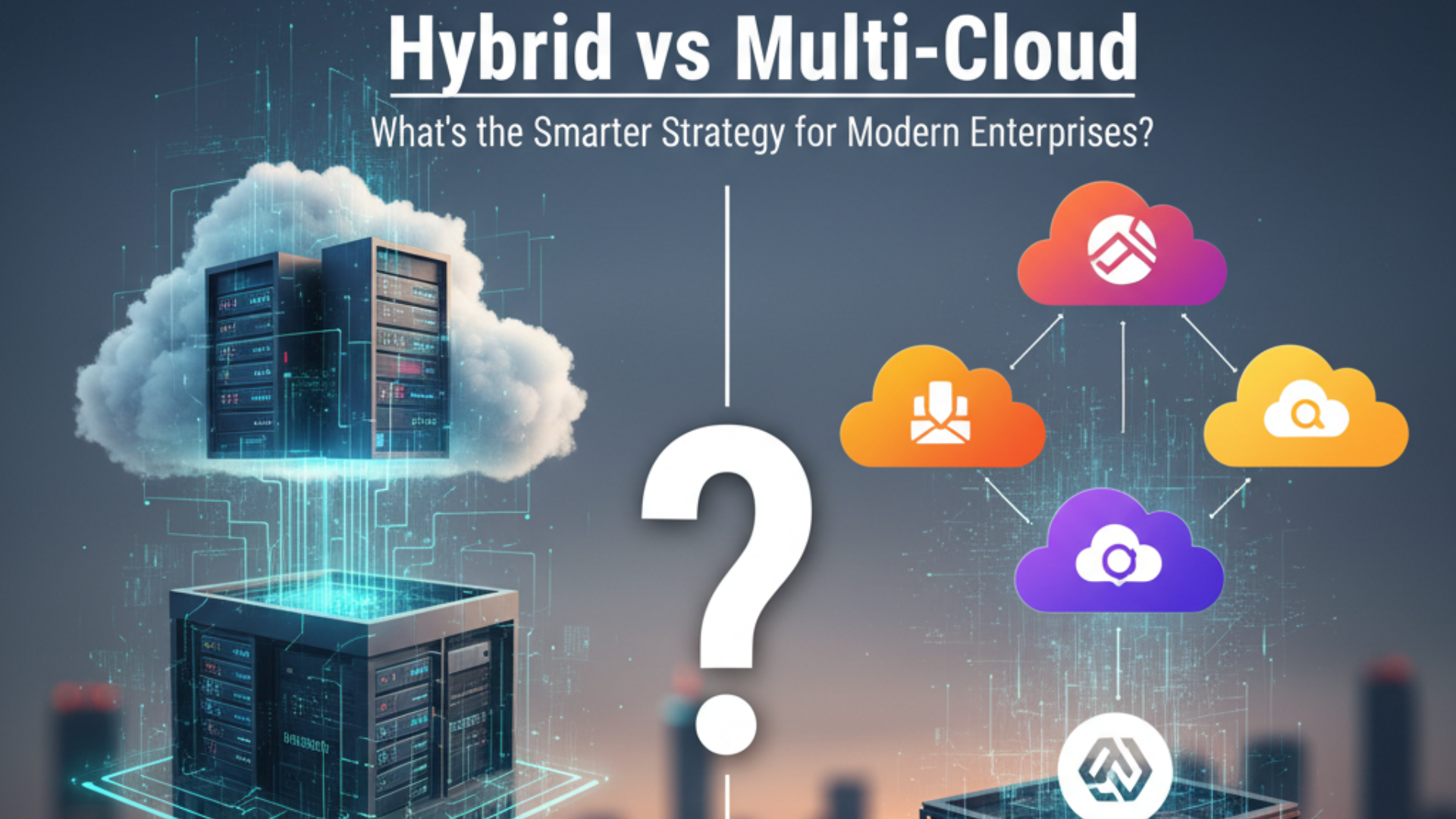
Hybrid vs Multi-Cloud: What’s the Smarter Strategy for Modern Enterprises?
Introduction:
It means picking the right cloud strategy to guarantee scalability, flexibility, and security while making sure organizations remain increasingly digitally driven. Hyadrid Cloud, Multi-Cloud are few of the top most talked cloud strategies. But which one should the modern business choose? This article will unpack each model, outline pros and cons of each approach, and help you identify which cloud strategy is the right fit for your enterprise.
Understanding Cloud Computing:
Now, before we get into the distinctions around Hybrid and Multi-Cloud strategies, we first need to begin with the core of cloud computing.
What is Cloud Computing?
Cloud computing is the on-demand availability of computer system resources, especially data storage and computing power, without direct active management by the user. This allows businesses to access and manage resources remotely instead of having to rely on their local servers or personal devices.
There are three main divisions in cloud models.
Public Cloud – This is run by third-party providers including AWS, Microsoft Azure, or Google Cloud.
Private Cloud : A cloud infrastructure operated solely for a single organization.
Hybrid Cloud: Combination of public and private cloud.
Multi-Cloud: multiple cloud providers, most often multiple public clouds.
Hybrid Cloud: Combination of Private and Public Cloud
What is Hybrid Cloud?
Hybrid Cloud – meaning a mixture of on-premise data centers or private clouds connected with public cloud services with the ability to share data and applications between them. This provides businesses with more freedom to migrate workloads in and out of private and public clouds according to their needs, cost and security needs.
Benefits of Hybrid Cloud:
For example, businesses are able to scale their infrastructure as needed using the public cloud to provide for short-term, variable demand while concentrating critical or sensitive data with the private cloud.
Cost-Efficiency: Hybrid clouds help businesses save on costs with frequent operations in private clouds (low cost) and migrate to public clouds for high-capacity workloads.
Security & Compliance: Some industries have strict regulatory requirements; A Hybrid Cloud helps them in leveraging public cloud while still keeping sensitive data in private environments.
Performance Optimization: Hybrid enables better performance by running critical time-sensitive applications on private cloud resources while placing less critical or resource-hungry tasks on public cloud resources.
Challenges of Hybrid Cloud:
Management Complexity: Management of a hybrid environment can be challenging since private and public cloud platforms must be integrated.
Hybrid clouds mean better security, yet these environments can be a tangled web that leads to unmonitored security gaps.
Cost Explosion: Data is cheap but prone to cost explosion if not managed appropriately, especially due to its movement across the clouds.
Multi-Cloud: Leveraging Multiple Providers
What is Multi-Cloud?
Multi-Cloud: adopting services from multiple different cloud vendors like Amazon Web Services (AWS), Microsoft Azure, and Google Cloud. Multi-Cloud, while similar to Hybrid cloud in that it combines clouds, only relates to public cloud providers.
Benefits of Multi-Cloud:
No Vendor Lock-In: Businesses reduce their reliance on a single vendor and make sure not to get stuck in one vendor’s trap of limitations or pricing by working with multiple cloud providers.
Enhanced Reliability and Availability – Multi-Cloud ensures increased uptime by spreading workloads on different cloud environments. This way, if one provider goes down, the remaining can cover for them.
Best of breed — All clouds are not created equal. A Multi-Cloud strategy provides an opportunity for businesses to benefit from the variety of features provided by each one, be it AI, data analytics, or economical storage.
Greater Redundancy: If you use more than one cloud provider, you are already enabling better recovery because your operations will not be disrupted with the same fraction of external cloud service providers going down.
Challenges of Multi-Cloud:
Integration complexity: It is difficult to integrate, optimize performance, and secure your cloud applications if you are running more than one cloud.
And, management is the worst, with several different contracts, and monitoring systems from various cloud providers that is also costing too many resources.
Data Management & Compliance Issues: Managing the compliance of data you have hosted on different clouds with legal and regulatory requirements can be a growing, expensive problem.
Service Management Fragmentation: When working across multiple clouds, the coordination between services or tools may be fragmented and require more sophisticated management approaches.
Hybrid vs Multi-Cloud: Key Differences
Approach to Cloud Infrastructure:
Hybrid: A combination of both, focused on taking advantages or benefiting both public and private — Security, Compliance, and performance requirements.
Multi-Cloud: Applies to multiple public cloud providers, usually based on the best of all worlds, by optimizing cost, scalability, and performance.
Cost and Scalability:
Hybrid Cloud: Economical for businesses that are required to securely preserve sensitive information within private clouds, but also need the scalability provided by public clouds.
Multi-cloud: Greater flexibility and scalability, such as the ability to select providers based on specific needs, but overall higher costs due to increased complexity and the requirement to manage multiple platforms.
Security:
Hybrid Cloud: Normally, more security control as sensitive data can stay on private infrastructure and only lesser critical workloads relocating to public clouds.
Multi-Cloud: Security is uncentralized amongst multiple providers, making it potentially difficult to monitor, but gaining redundancy and resilience.
Vendor Lock-In:
Hybrid Cloud — Also, to some extent vendor lock in through your private cloud provider if they would want to do it.
Multi-Cloud — Provides better agility by not getting tied to one single-cloud provider
What Kind Of Cloud Strategy Fits Your Business
When to Choose Hybrid Cloud:
When your business needs an optimum mix of security, cost-effectiveness, and scalability.
When you might need to keep a private cloud on-premises or in a private cloud environment for critical data.
If you belong to a highly regulated industry as well and Data Compliance is an issue.
When to Choose Multi-Cloud:
If you would like to have more flexibility and to avoid vendor lock-in.
When you want to tune performance by using the best tools available from different Cloud providers.
When redundancy, reliability, and uptime are requirements.
Conclusion:
The only constant in the fast-moving digital landscape is that there is no silver-bullet that seamlessly addresses the cloud adoption aspect. Your decision on Hybrid Cloud or Multi-Cloud is dependent on your company needs whether you want security, compliance or need flexibility or you want full control over your data and infrastructure for your business. Both strategies come with clear benefits, but what matters more is how you align your cloud stack with your long-term goals.
Whichever of those strategies you opt for, the backbone of the cloud infrastructure will be crucial for innovation, efficiency and preparing your business to be in a position to drive success and adapt to the future.
Final Thoughts:
Navigating the Hybrid vs Multi-Cloud conversation is essential for enterprises looking to remain competitive in the modern day. Evaluating your business needs and resources, you can choose a cloud strategy that meets your goals by providing scalability, cost-effectiveness, and security in an ever-changing digital environment.
Recent Comments
- No comments to show