
-
Suresh Kalal
- November 20, 2025
- Cloud
- No Comments
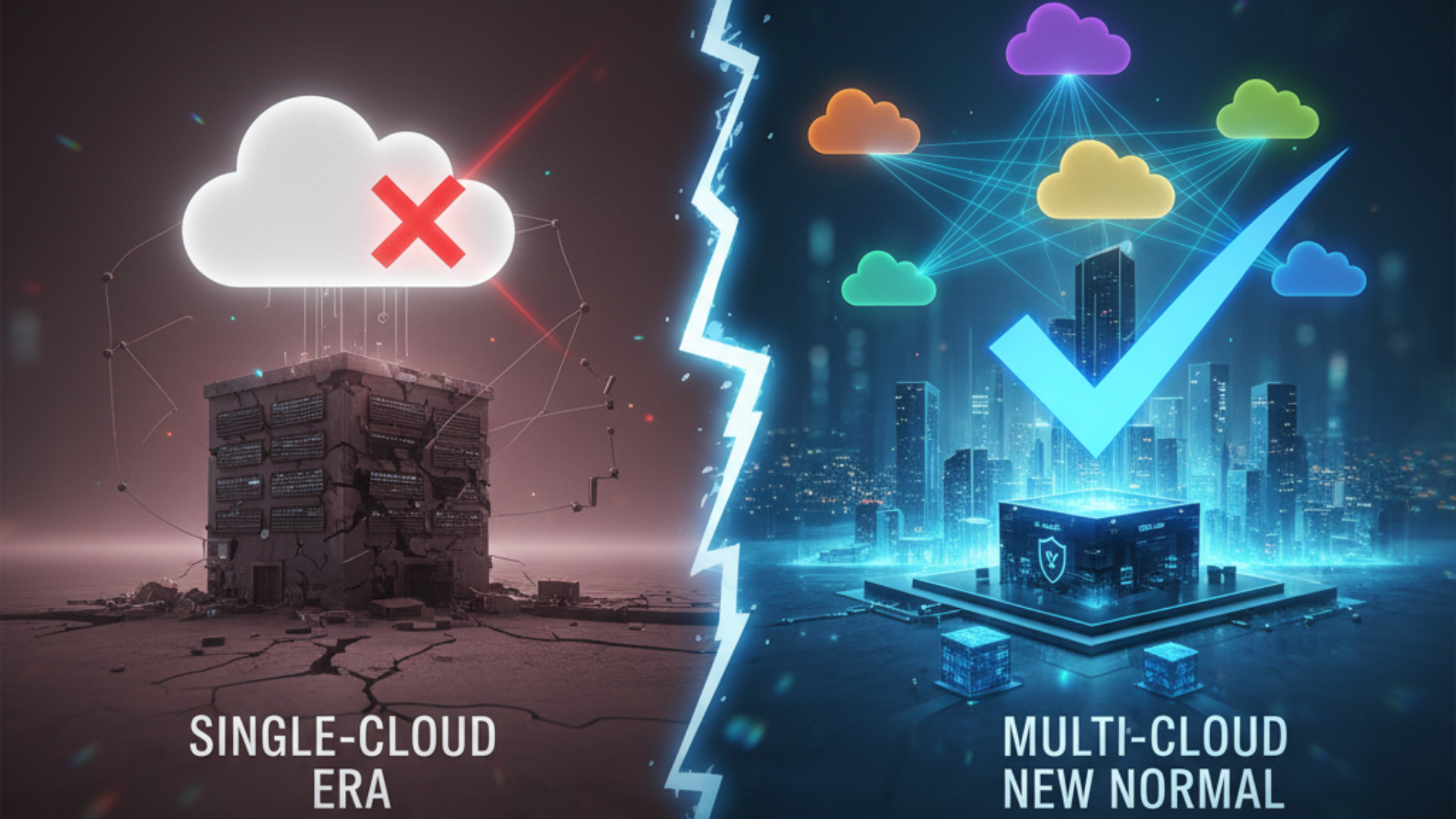
The Death of Single-Cloud: Why Multi-Cloud Is the New Normal
It changed the way businesses operate by introducing flexibility, scalability, and cost-saving options as we never had before. The single-cloud model — centered on an individual provider like AWS, Microsoft Azure, or Google Cloud — dominated the way enterprises approached their cloud strategy for years. Nevertheless, with the evolution of the digital landscape, businesses are embracing multi-cloud strategies.
The reason? In the current fast-paced, security-centric, performance-oriented climate, single-cloud systems are not cutting it anymore. This post will look at why multi-cloud is becoming the new normal, how it is beneficial for businesses, and what the future of cloud computing holds for us.
One-Look: The Upward Spiral of One Cloud
Now we need to enter into the multi-cloud world, but first, let us process the massive adoption of single-cloud solutions.
Other businesses found it seamless to dump infrastructures by leveraging single-cloud model. Cloud providers had a comprehensive portfolio of offerings, from computing power to storage, enabling businesses to bring all their IT infrastructure in-house (with a vendor) while reducing the complexity of managing on-prime hardware and software.
This trend gave rise to single-cloud providers, AWS, Azure, Google Cloud, and others soon raced in to offer business solutions aimed at companies of all sizes. Easier to promise flexibility, cheaper, and it was easy to scale that stuff up fast. Yet, as organizations became more cloud-reliant, the downsides of a sole-provider approach began to rear its ugly head.
Why Single-Cloud Is Dying
Here, we discuss some key reasons why the single-cloud model is falling out of favour among businesses today. Now let’s go into a bit more detail:
Lack of Flexibility
A single cloud provider usually serves as a good solution, but might not be the best one for every need of the business. Different cloud providers come up stronger in different services like computing power, machine learning, storage, security features, etc. Choosing one provider = Missing out on best-of-breed tools for the job
E.g. a cloud provider may have better analytic services or one may offer better storage solutions. When using a single-cloud strategy, companies often have to compromise on a provider that may not be suitable for all requirements.
Risk of Vendor Lock-In
The risk of being locked in by a vendor is one of the biggest disadvantages of the single-cloud model. This leads to a scenario where a company has become so dependent on one specific cloud providers services, APIs or infrastructure that it is almost impossible to move from one provider to another.
And it potentially puts the business at risk if the provider they choose decides to change its pricing model, ends up discontinuing critical features, or even experiences outages. Vendor lock-in acts as a barrier to rapid adoption of technology or even changing to a vendor providing better solutions at a lower cost;
Security and Compliance Concerns
Security is the leading issue in the minds of organizations that have shifted to cloud options. Top cloud providers certainly put a lot of resources into security, but, if a provider suffers a data breach, downtime, or any issue with its infrastructure, a single-cloud model still puts the businesses footprint at risk.
Also, organizations in heavily regulated sectors (finance, healthcare, etc.) may have more work to do to be in compliance. One cloud provider cannot give the geographic redundancy and data protection that follows regulations.
Downtime and Service Outages
Downtime is unavoidable for any cloud vendor. AWS, Azure, and other big providers are not immune from outages sniping across their data centers, causing varying outage footprints impacting millions of customers. Using a single-cloud strategy means that the businesses have no choice if anything goes wrong with the chosen provider. On the flip side, multi-cloud setups offer redundancy; when there are problems with one provider, the company is protected and can use another provider to keep the operations running fine.
Why Multi-Cloud Is the Future
Considering the drawbacks of single-cloud models, multi-cloud is not a buzzword anymore. Now, What Is A Multi-cloud Environment?
This means running at least part of your workload on more than one cloud provider, a strategy which is referred to as multi-cloud. With this method, companies can cherry-pick the that work for them from each provider resulting in a cloud infrastructure that is deep-rooted, yet agile and modular.
This is why has become the new normal:
Enhanced Flexibility
One of the primary benefits of a multi-cloud strategy is using the best of each provider. Organizations are free to select specific offerings from AWS, Google Cloud, Azure, or other providers to put together a cloud architecture that meets their requirements.
An organization can make use of AWS for computing, Google Cloud for all the AI and machine Learning work, and Azure for storage and compliance, etc. This flexibility enables enterprises to harness the maximum power of the unique capabilities of each provider with no lock-in to one cloud provider.
Improved Reliability and Redundancy
Using multiple cloud providers means workloads spread out, lowering the downtime risk for companies. If one provider has an outage, services running on the other provider stay unaffected and keep the operations running.
Such geographic, failover-cloud redundancy is crucial to businesses with high-availability and uptime requirements.
Cost Optimization
One of the most exciting benefits to businesses of a multi-cloud strategy are the tools and methods available to allow them to effectively minimize their costs by taking advantage of price differentials on constantly evolving services between cloud providers. And by the way, one provider has cheaper compute services, the other one has more affordable storage. This allows businesses to choose services from other providers according to their price point while being able to use the service that gets them the best performance.
Avoiding Vendor Lock-In
A multi-cloud or sometimes referred as multi-cloud strategy helps businesses reduce the cloud vendor lock-in by distributing the bouquet of cloud services. They are no longer beholden to single provider tentacles, affording them more negotiating leverage — and a way to quickly switch out providers or migrate workloads as necessary.
This is especially essential for companies who are looking to make sure their future is flexible when it comes to the ever-changing cloud landscape.
Increased Security
Using more than one cloud provider allows companies to diversify their risk, instead of keeping everything in one basket. Businesses can also benefit from enhanced security targeting with each provider security capabilities and services within a multi-cloud environment. For example, one of them may provide an excellent threat detection mechanism, while the other one specifically underlines encryption and data protection mechanisms. This multi-layer security system reduces the risk of potential threats.
The Challenges of Multi-Cloud Adoption
Although the multi-cloud approach provides several advantages, at the same time it poses some challenges. Although the hurdles which businesses fail to cross are common, however, the most prominent ones are:
More Complexity – It is more complicated to handle multiple cloud providers than using a single one. Businesses need to ensure that they possess proper tools, processes, and experience required to manage multi-cloud effectively.
Integration and Interoperability: Cloud providers have their own tools, APIs, and management consoles, leading to increased integration complexity across services. It means that organizations need to ensure that their systems and applications are able to function in an interoperable manner across several clouds.
Charge Management: Multi-cloud can help start re-optimising, although its also prone for increasing the cost if poorly managed. With usage across several clouds difficult to track, proper cost management practices are essential from the outset.
The future of the cloud is a multi-cloud, and you can reinterpret the data that enables these solutions.
The demise of single-cloud is as much the natural evolution than a transition. The need for flexible, secure, and resilient solutions cannot be understated as businesses transition to digital transformation. The multi-cloud offers agility to allow the adoption of new technologies, the means to avoid being locked into a vendor, and redundancy to guarantee uptime.
And with the ever-evolving landscape of the cloud — ain multicloud by far no longer a simple competitive advantage, but a bolted-on business-as-usual practice to ensure that all ships are always afloat come storm weather — you actually want to be the type of shop that has the ability to roll with the punches no matter what emerges, the type of entity that hosts a cloud, not the type of entity that has to capitulate management of their own cloud.
In our ever more data- and digitalservices-centric world, the multi-cloud is no more an option — it is a must.
Recent Posts
- IT Staff Augmentation in Ahmedabad: A Guide for CEOs Hiring Their First Outsourced Engineer
- Why Ahmedabad's IT Talent Shortage Is Pushing Companies Toward Staff Augmentation
- Setting Up IT Infrastructure in Ahmedabad's New Business Parks: What Nobody Tells You Upfront
- Why GIFT City and Gandhinagar Companies Need a Different IT Infrastructure Approach Than Ahmedabad Offices
- Managed IT Services in Ahmedabad: What Local SMBs Pay vs. What They Actually Need
Recent Comments
- No comments to show