
-
Suresh Kalal
- November 10, 2025
- IT
- No Comments
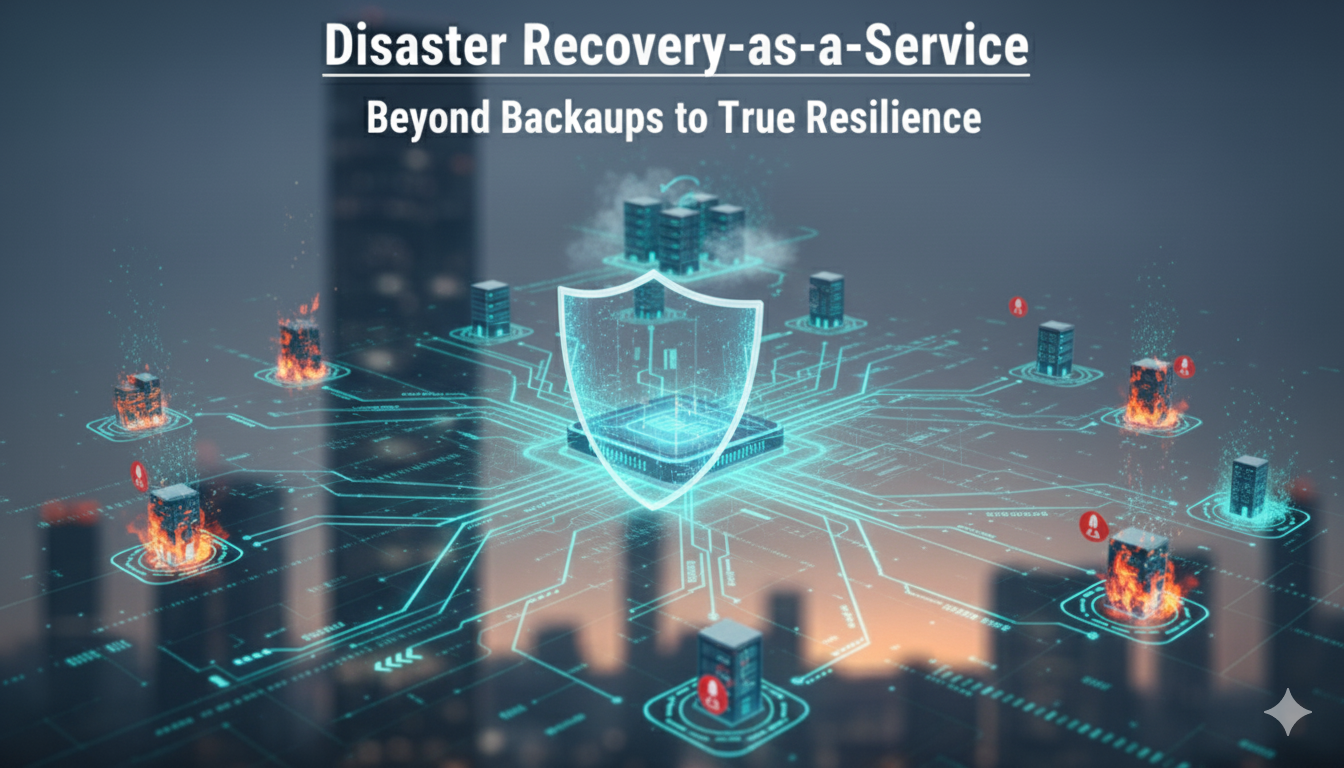
Disaster Recovery-as-a-Service: Beyond Backups to True Resilience
Introduction:
Today, when everything is fast-paced and data-oriented, downtime can cost a lot for businesses. Business operations are disrupted by inactivity, whether it is due to disaster recovery, cyberattacks, or hardware failures, leading to staggering revenue losses and loss of customer trust. Most of the organizations today would like to have their data backed up and that is great but more than that, Disaster Recovery-as-a-Service (DRaaS) is also a solution that comes out for you. This goes beyond traditional backups to deliver true business protection. In this article, we will look at what DRaaS is, how it works, and the reasons why it is a critical component of modern business continuity strategies.
What is Disaster Recovery-as-a-Service (DRaaS)?
Understanding DRaaS:
Disaster Recovery-as-a-Service (DRaaS) is a cloud-computing service model that enables businesses to back up and recover their data, applications, and IT infrastructure in the face of a disaster. DRaaS differs from traditional disaster recovery methods — usually employing on-premises infrastructure or burdening human resources with complicated steps — by automating and simplifying the entire recovery process. DRaaS is fully managed by the providers so the organizations can recover quickly with a minimal amount of disruption and data loss.
How Does DRaaS Work?
Disaster Recovery as a Service (DRaaS) means the replication of essential systems, applications, and data into a safe cloud environment. Businesses can bring services back up in minutes, keeping mission-critical functions running during a disaster. Key components of DRaaS include:
Automated Backups — Scheduling regular and automated backups of systems, data, and applications.
Replication : Ongoing replication of workloads to the cloud in order to keep the data in sync in real-time.
Failover — The capability to seamlessly move to backup systems available in the cloud when primary systems fail.
Orchestration: A control center for managing and automating recovery procedure
Why DRaaS Is Important for Today’s Enterprises?
Beyond Traditional Backups:
Traditional backups usually store data at one time snapshot: on external disks or local data centers. Although backups are necessary, they are not sufficient to ensure business continuity when an unfortunate incident turns your life upside down. DRaaS isn’t only about backing up data, but also about having a disaster recovery strategy that replicates entire IT environments, including operating systems, applications, configurations, and services.
Business Continuity: DRaaS gives businesses the ability to operate despite the inability to access their infrastructure.
Instant Data Recovery: Using the DRaaS model, data is replicated continuously, which means that the window of data loss risk is virtually zero.
Minimizing Downtime:
We’ve seen downtime costing some business thousands of dollars per minute while damaging its reputation and customer trust. How quickly an organization is able to bounce back from a disaster directly impacts the costs incurred during the downtime. DRaaS time to recovery is far lower than for traditional methods.
RTO: One of the compelling advantages of DRaaS services is the RTOs they promise: in most cases, recovery within minutes or hours, rather than days.
Continuous Availability — Deploying applications and data in the cloud helps organizations avoid downtime by allowing them to quickly failover to a backup system instead of waiting for hardware replacement or lengthy recovery processes.
Cost-Effectiveness:
Conventional disaster recovery solutions are expensive due to the costs of maintaining remote data centers, hardware, and personnel to supervise the recovery operations. By utilizing cloud resources, DRaaS provides a cost-efficient and scalable alternative.
Lowering Infrastructure Expenses — As DRaaS removes the need for a secondary, physical DR site. Instead, companies can utilize the DRaaS providers cloud infrastructure.
Pay-As-You-Go Approach: Most DRaaS vendors provide on-demand, pay-per-use prices that can save businesses money by eliminating the need for expensive hardware that sits idle on-premises.
Scalability and Flexibility:
DRaaS offers scalability and flexibility that traditional solutions cannot compete with. As organizations develop, their disaster recovery requirements alter, and DRaaS is an easy scale with it.
Flexible Plans: Disaster recovery solutions can be adjusted according to the organizational requirements such as how many systems to be protected, the amount of redundancy, and how frequent should be the backups.
Cloud and On-Premises Infrastructure Compatibility: DRaaS can be used to safeguard the on-premises IT infrastructure while having the ability to protect most cloud-based environments as well, which is essential for hybrid environments.
Enhanced Security:
With growing cyber risks and data compromises, security is one of the biggest concerns for businesses. DRaaS providers are also known for providing enhanced security for data protection in recovery.
Encryption-in-transit and at-rest — Your data is encrypted in transit, where it is sent from your device to the cloud provider, and at-rest, where your data is stored (i.e., accessed to send/share a video, document, etc.).
Adherence to Regulations: Numerous DRaaS suppliers meet operational benchmarks and administrative conditions (for example, GDPR, HIPAA). They help organizations uphold their lawful responsibilities concerning information security.
How DRaaS Improves True Resilience
Holistic Disaster Recovery Plan:
Traditional backup methods tend to be more reactive whereas DRaaS enables businesses to take a proactive approach to disaster recovery. With a comprehensive disaster recovery plan, businesses can prepare for all sorts of threats — from a cyberattack to a natural disaster.
Proactive Approach Towards Risk ManagementDRaaS ensures preparedness before disruptive events occur consequently preventing data loss and downtime.
Automated testing– To make sure that everything works as intended, a number of DRaaS providers offer automated disaster recovery testing, allowing businesses to verify their recovery procedures without interrupting their normal operations.
Seamless Failover and Failback:
Businesses for that reason require being able to efficiently transition to backup systems, and restore service as standard in an emergency. With DRaaS, failover and failback are seamless, so downtime is less severe and the recovery process is as painless as possible.
Failover: The primary system switches to a backup environment when the primary system goes down automatically.
Failback: After recovery of the primary system is achieved, DRaaS helps in returning to the original environment with no data loss or application downtime.
Business Continuity Across Multiple Locations:
For businesses with different locations, DRaaS is capable of disaster recovery with centralized management so that all sites have continuity assurance. DRaaS means that all locations, whether they are a regional office or a global headquarters, are protected under the same recovery plan.
International Dependability: DRaaS can ensure uniform and dependable disaster recovery in every region for businesses with international offices.
While the DRaaS enhances orchestration capabilities, and ensures a smoother recovery process across all the locations.
Top 3 Considerations When Selecting a DRaaS Provider
There are lots of merits to DRaaS, but potential providers should be vetted thoroughly. Key factors to consider include:
Service Level Agreements (SLAs): Hold the provider accountable with clear SLAs regarding recovery times, availability, and support.
Security Features – Evaluate the provider security features such as encryption, access controls and compliance certifications.
Flexibility: Select a provider that can scale along with your firm, which can be necessary to your firm’s evolution and growth.
Customization: Ensure that the provider can offer you solutions that are flexible and in line with your specific recovery goals and business needs.
Conclusion:
DRaaS is more than a backup solution — it is the backbone of today modern business resiliency strategies. DRaaS provides extensive, cloud-based disaster recovery that allows organizations to quickly recover from disasters, masking downtime, and safeguarding critical data and applications. DRaaS will make sure you are not only backing up data but you are preparing your entire infrastructure for the next disaster whether you are small business or a large enterprise.
With businesses getting more reliant on digital solutions, having a solid disaster recovery plan, which is both scalable and secure, is a crucial step in safeguarding business operations against unexpected disasters. DRaaS enables organisations to refocus on building and developing their services without fear of downtime, confident that their most critical systems are safe and only a button-push away from restoration.
Final Thoughts:
Conclusion: DRaaS is the Next Technology Evolution for True Business Resilience DRaaS offers a modern approach to business continuity that aligns with the evolving landscape of business technology. DRaaS goes beyond traditional backups, allowing businesses to create a comprehensive disaster recovery plan that ensures they can achieve minimal downtime, stronger data protection, and better overall business continuity.
Recent Posts
- IT Staff Augmentation in Ahmedabad: A Guide for CEOs Hiring Their First Outsourced Engineer
- Why Ahmedabad's IT Talent Shortage Is Pushing Companies Toward Staff Augmentation
- Setting Up IT Infrastructure in Ahmedabad's New Business Parks: What Nobody Tells You Upfront
- Why GIFT City and Gandhinagar Companies Need a Different IT Infrastructure Approach Than Ahmedabad Offices
- Managed IT Services in Ahmedabad: What Local SMBs Pay vs. What They Actually Need
Recent Comments
- No comments to show