
-
Suresh Kalal
- February 9, 2026
- No categories assigned.
- No Comments
24×7 Support Importance: Why Overnight NOC and Global Coverage Are Now Non-Negotiable
Over the last decade “always on” IT went from being a competitive advantage to simply a table-stakes requirement. Systems don’t sleep, global users don’t stop and incidents definitely don’t adhere to a nice 9–5 schedule. Still, many IT teams work with frameworks that were developed for a very different era, one in which after-hours support was optional and downtime an acceptable price.
Today, it’s the opposite. A single interrupt of service can cause lost revenue, SLA violations, customer ire, negative PR and a serious backlog that becomes an avalanche until the next week. The simple truth is this: 24/7 coverage isn’t a luxury anymore; it’s operational survival.
So this is where the overnight NOC coverages, global models of support and innovative staff augmentation alternatives really come into play on a larger scale than we have seen previously.
Why 24×7 Support Has Become the New Normal
There are three major shifts driving the need for continuous support, and each of them is accelerating faster than most organizations expected.
1. Multi-region service delivery is now standard
Even companies that aren’t “global” by nature behave like global organizations. Cloud platforms, distributed development teams, SaaS tools, remote employees, and customers in multiple time zones create a 24-hour demand cycle.
If something breaks at 2 AM, it still matters. Someone, somewhere, can’t work.
2. The threat landscape operates on its own clock
Cyberattacks don’t wait for office hours. Automated threats, credential stuffing, exploitation attempts, and DDoS patterns often peak during off-hours when internal IT teams are the least prepared.
Overnight detection is no longer react-and-fix—it’s prevent-and-contain, instantly.
3. Digital experience has zero tolerance for downtime
Users expect applications to load instantly and infrastructure to work flawlessly. A maintenance window that was “acceptable” a few years ago is now viewed as friction.
24×7 monitoring isn’t about catching issues anymore; it’s about ensuring business flow never stops.
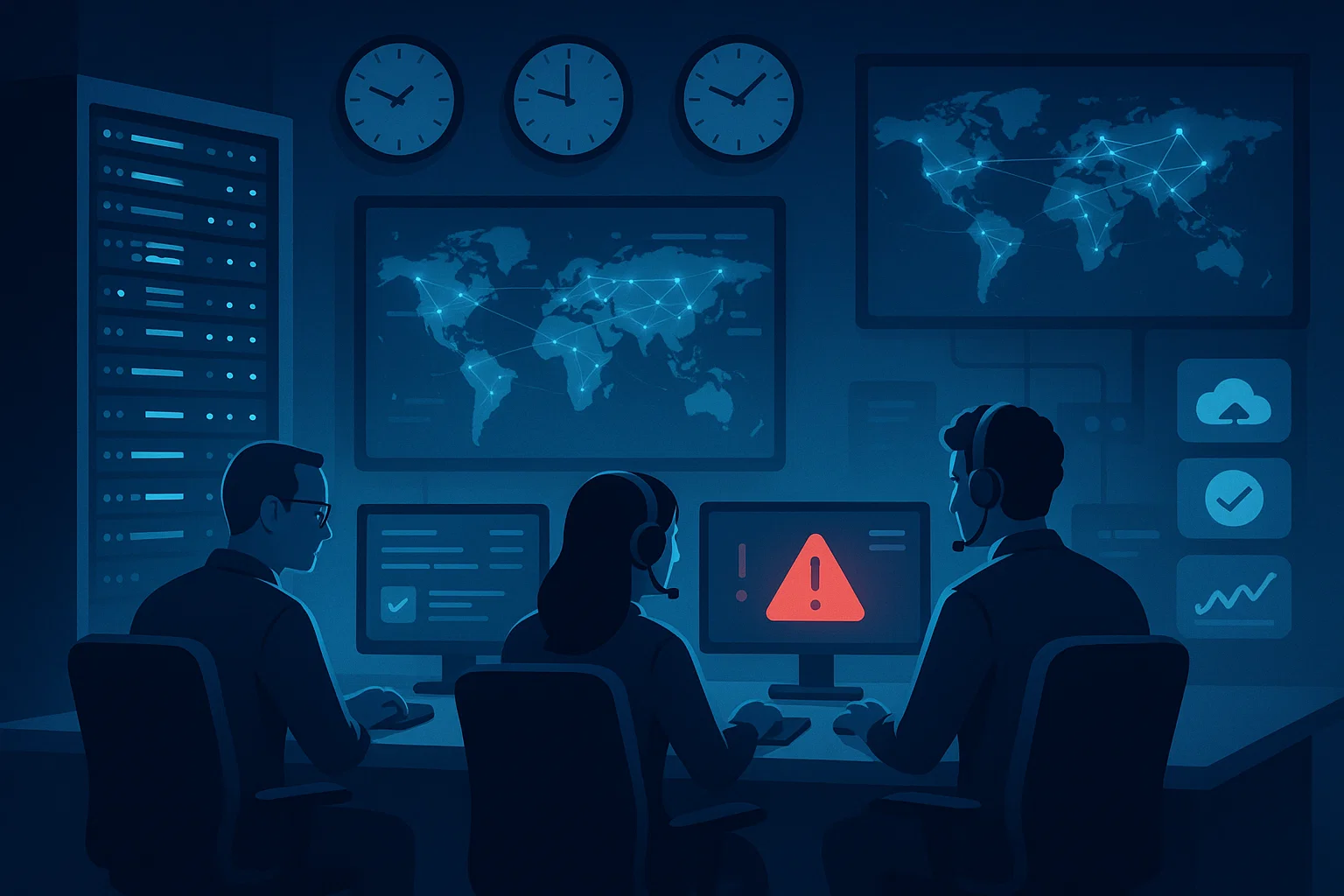
The Overnight NOC: The Real Backbone of 24/7 IT
A Network Operations Center (NOC) isn’t just a team watching dashboards. It’s the command center responsible for keeping the entire IT environment stable, predictable, and recoverable—every hour of the day.
Many organizations rely on their internal teams to cover nights and weekends, but this creates predictable problems:
- Fatigue from on-call rotations
- Rising burnout among senior engineers
- Higher error rates during critical escalations
- Increased turnover and hiring pressure
- Slow response times during off-hours
- Operational gaps during holidays or peak workload seasons
An overnight NOC solves these challenges by taking over the responsibility of monitoring, troubleshooting, and restoring service when the internal team is offline.
It ensures that:
- Alerts are never ignored
- Escalations happen instantly
- Infrastructure remains continuously stable
- Incidents don’t pile up for the morning shift
- Maintenance windows are handled efficiently
- Threats are intercepted before spreading
The value isn’t just in the number of people—it’s the consistency of coverage.

Global Coverage—Not Just “Outsourcing,” but Operational Continuity
“Global coverage” is often misunderstood as simply outsourcing nighttime work overseas. But the modern concept is more strategic.
It blends:
- Follow-the-sun support models
- Geo-distributed monitoring teams
- Cross-time-zone redundancy
- Cloud-native visibility across all infrastructure layers
This creates what internal IT teams rarely achieve on their own:
a 24×7 service model that never dips in capability or quality.
The benefit is twofold:
- Incidents get resolved before they escalate.
No waiting, no tickets sitting idle for hours. - Daytime teams start clean every morning.
They can actually focus on architecture, projects, and improvements instead of firefighting leftovers from the night.
When done right, global coverage transforms IT from reactive to reliably proactive.
After-Hours Support: The Silent Force Preventing IT Backlogs
Most IT leaders don’t realize how much after-hours downtime contributes to internal backlog.
Take a common scenario:
- A backup job fails overnight.
- A server hits 95% CPU at 3 AM.
- A database replication queue stalls.
- A cloud resource starts consuming more cost than expected.
- A firewall policy update triggers an unintended block.
If no one is there to fix these in real time, a small problem becomes hours of work the next day. Now multiply this by 20–30 similar issues happening every week.
That’s how backlogs form—and why after-hours support has become the “invisible lever” behind stable IT operations.
Why Traditional Staff Augmentation Struggles to Solve the 24×7 Challenge
The default solution for most companies has always been staff augmentation—hire more people, add more shifts, expand the team.
But this model begins to break when organizations try to scale it across 24-hour coverage.
1. The cost model stops making sense
Maintaining full-time engineers across 3 shifts is extremely expensive. Even for mid-sized environments, this creates:
- HR strain
- High salary overhead
- Benefit and compliance obligations
- Training investments
- Management complexity
The real cost of “round-the-clock” internal staffing is far higher than most budgets allow.
2. Overnight talent is very hard to retain
Engineers don’t want permanent graveyard shifts.
Retention becomes a constant battle, especially when competitors offer better hours.
3. Skills degrade without continuous practice
If your night shift handles minimal incidents, escalation readiness drops.
Conversely, if they handle too much, burnout rises.
4. Teams become inconsistent between different time zones
Processes drift, communication weakens, and cultural gaps emerge.
This is where organizations began shifting from staff augmentation to NOC offloading—not as outsourcing, but as a strategic operational model.
The Rise of NOC Offloading: A More Efficient Alternative
NOC offloading takes responsibility for night-time and off-hour operations and moves it to a team that is:
- Already trained to work overnight
- Already equipped to run 24×7
- Already structured for redundancy
- Already skilled in L1/L2 triage and L3 escalation workflows
- Already familiar with cloud, hybrid, and on-prem infra
- Already working with established SOPs and automation workflows
You’re not hiring more people—you’re eliminating the need to.
With NOC offloading, internal teams get:
- Restored work-life balance
- Capacity to focus on long-term improvements
- Freedom from night-time firefighting
- Better productivity during business hours
- Stability without over-hiring
And the business gets:
- 24×7 uptime
- Global coverage
- Lower operational cost
- Faster MTTR and higher SLA performance
- Predictable monthly spend
- Improved security posture
It’s one of the few operational models where cost savings and performance improvements happen simultaneously.
How Overnight Coverage Strengthens Security and Compliance
Security frameworks such as ISO 27001, NIST, SOC 2, and CIS all emphasize continuous monitoring and response.
This is because the majority of attack attempts and lateral movement occur during:
- Early morning hours
- Holiday periods
- Weekends
- Times of reduced internal staffing
Overnight NOC teams act as the first line of defense by:
- Detecting anomalies
- Identifying suspicious traffic
- Responding to performance deviations
- Executing immediate isolation and mitigation steps
- Maintaining continuous logs and audit trails
- Preventing alert fatigue during the day
With regulations tightening across industries, 24×7 security monitoring is not just best practice—it’s becoming a compliance requirement.
The Business Case: 24×7 Coverage Pays for Itself
Organizations that adopt overnight NOC and global coverage usually see measurable gains across several areas:
Reduced downtime
Every minute of uptime preserved is direct business value retained.
Lower operational cost
Replaces high-cost staffing models with a predictable alternative.
Higher team retention
Engineers stay longer when they aren’t crushed by on-call fatigue.
Better project throughput
Teams shift from incident-heavy days to productive sprints.
Improved customer confidence
Nothing improves trust more than infrastructure that simply never sleeps.
Stronger competitive positioning
24×7 capability improves SLAs, service quality, and delivery reliability.
The ROI makes itself obvious very quickly.
The Future: 24×7 as a Given, Not an Upgrade
With hybrid cloud, edge computing, remote workforces, and real-time security threats accelerating, we’re heading toward a world where every IT environment is always-on by default.
That means every IT team—whether it’s a startup, MSP, enterprise, or ISV—needs the ability to operate continuously.
Not reactively, not intermittently, but consistently.
Overnight NOC coverage isn’t just going to be useful.
It’s going to be the expected standard of operational maturity.
Organizations that adopt this model now won’t just “keep up”—they’ll gain capabilities their competitors are still years away from building internally.
Conclusion
Building 24×7 support with an internal team alone is becoming unrealistic.
The cost, complexity, staffing challenges, and burnout risk make it an uphill battle. In contrast, overnight NOC offloading and adopting a global coverage model offer a practical, scalable, and financially predictable alternative.
The combination of:
- round-the-clock coverage,
- overnight support,
- NOC offloading, and
- modern alternatives to staff augmentation
creates an environment where IT stability is not just maintained—it is guaranteed.
For companies navigating growth, modernization, compliance, or transformation, this model isn’t just a useful option.
It’s the operational backbone that ensures everything else can scale.
Recent Comments
- No comments to show